
Discover the crucial role of analytics in financial marketing. Learn how data transforms strategies, boosts ROI, and drives success.
The Role of Analytics in Financial Marketing Strategy

Analytics in financial marketing refers to the systematic use of data to measure, optimize, and scale marketing performance across every channel a financial brand operates. The financial analytics market is projected to reach USD 32.13 billion by 2031, growing at a CAGR of 11.53%. That number reflects how deeply financial services firms have accepted that gut-feel marketing is finished. Tools like Google Analytics 360, Marketing Mix Modeling (MMM), cohort-based ROAS models, and machine learning now define how serious financial marketers allocate budgets, prove ROI, and comply with regulations while still growing.
What is the role of analytics in financial marketing?
The role of analytics in financial marketing is to convert raw behavioral and transactional data into decisions that improve targeting, attribution, and budget efficiency. Without it, financial marketers operate on incomplete signals, misattribute conversions, and waste spend on channels that look productive but deliver no real revenue.
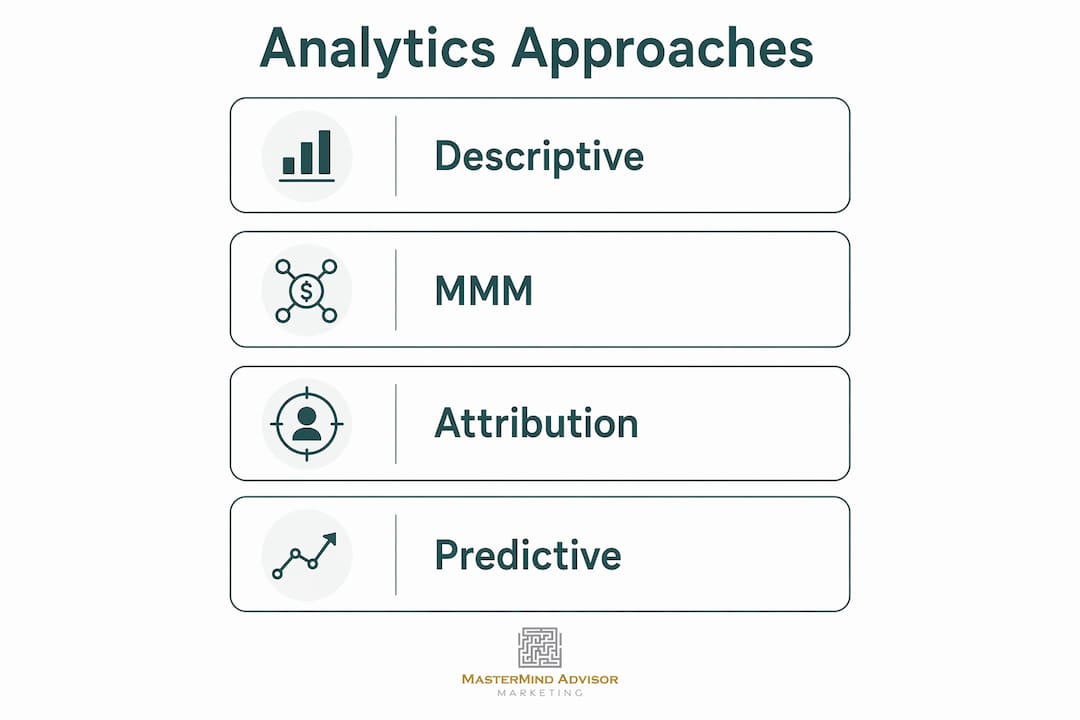
Four analytic approaches dominate the field today. Each solves a different problem, and the best financial marketing teams use all four in combination.
Descriptive analytics tracks revenue, cost per acquisition, click-through rates, and KPIs in real time. It answers "what happened" and forms the baseline every other method builds on. Google Looker Studio and Tableau are the most common tools for this layer.

Marketing Mix Modeling (MMM) answers "what caused it." MMM uses econometric regression to isolate the contribution of each marketing channel to revenue, independent of cookies or user-level tracking. Bayesian MMM is considered the gold standard for financial services because its informative priors stabilize ROI estimates in markets with limited data or high regulatory noise. The Frequentist approach works in data-rich environments but produces less stable outputs when sample sizes are constrained.
Full-funnel attribution maps the complete customer journey, including regulatory steps like Know Your Customer (KYC) verification that sit between a click and a deposit. Standard platform attribution ignores these intermediary steps entirely, which means it systematically overcredits channels that generate registrations and undercredits channels that generate actual depositors.
Predictive analytics and cohort-based ROAS project future revenue from current cohorts. Rather than measuring cost per registration, cohort ROAS tracks the lifetime value of users acquired through each channel, giving financial marketers a forward-looking view of which spend actually compounds.
| Method | Primary data source | Core benefit | Typical application |
|---|---|---|---|
| Descriptive analytics | CRM, ad platforms, web analytics | Real-time KPI visibility | Weekly performance reporting |
| Bayesian MMM | Aggregate spend and revenue data | Channel ROI without cookies | Budget allocation and planning |
| Full-funnel attribution | CRM plus ad platform data | Captures KYC and deposit steps | Regulated market measurement |
| Cohort-based ROAS | CRM lifetime value data | Forward-looking revenue per cohort | Scaling decisions and LTV optimization |
| Predictive analytics | Historical behavioral data | Scenario planning | Quarterly budget forecasting |
Pro Tip: Never run MMM and last-click attribution as competing models. Run them in parallel. MMM reveals channel-level truth; last-click tells you which creative or keyword closed the deal. Together they give you both the why and the how.
How does analytics address measurement challenges in financial marketing?
Measurement in financial marketing is harder than in most other sectors. Privacy regulations, fragmented data systems, and long conversion cycles all conspire to make standard attribution unreliable.
Traditional attribution misses 30 to 60 percent of actual marketing impact in GDPR-compliant markets. That is not a rounding error. It means a financial brand running last-click attribution could be cutting its best-performing channels because those channels influence early-stage awareness rather than final clicks.
The measurement confidence problem runs deep. 54.1% of marketers reported no year-over-year improvement in measurement confidence despite ongoing investment in new analytics tools. More tools without better data governance produces more noise, not more clarity.
The root cause is almost always fragmented data. When your CRM does not talk to your ad platform, and your ad platform does not share conversion data with your web analytics, you end up with three versions of the truth and no way to reconcile them. Fragmented data foundations consistently lead to poor decisions despite high analytics spend.
The most effective financial marketing teams address this with a layered measurement stack:
- Unify CRM, ad platform, and web analytics data into a single data warehouse (BigQuery or Snowflake are the standard choices)
- Implement event-level tracking that captures KYC completion, deposit events, and product activations, not just registrations
- Run MMM quarterly to recalibrate channel weights as market conditions shift
- Use cohort analysis to track 30, 60, and 90-day revenue per acquisition cohort by channel
"Financial brands must carefully track full-funnel user journeys including intermediary regulatory steps to avoid misleading attribution that favors registration over real revenue-generating actions." — Valiotti Analytics
Google Analytics 360 integrated with Google's Meridian MMM framework now allows financial marketers to run unified cross-channel measurement and causal performance tracking within a single platform. That integration closes a gap that previously required three separate vendors and a data engineering team to bridge.
What emerging analytics technologies are transforming financial marketing?
The most significant shift in financial marketing analytics right now is not generative AI. It is the convergence of MMM, predictive signals, and machine learning into platforms that previously only offered retrospective reporting.
Here is how the technology stack is evolving in 2026:
-
MMM inside Google Analytics 360. Google's integration of Meridian into Analytics 360 means financial marketers can run scenario planning directly inside their existing measurement environment. The Qualified Future Conversions metric links current ad spend to projected future sales, giving media buyers a forward-looking signal rather than a lagging one.
-
AI-assisted data interpretation. Machine learning models now surface anomalies, attribution shifts, and cohort degradation faster than any analyst can manually. IBM's research confirms that the CFO role is evolving from historical reporting to predictive analytics and machine learning to drive business strategy. The same shift is happening in marketing functions.
-
Generative AI for content and SEO. Financial marketers are using tools like ChatGPT and Google Gemini to produce compliant content drafts, test messaging variations, and interpret large data exports. The productivity gain is real, but the compliance risk is also real. Every AI-generated piece of financial content still requires human review against FCA, SEC, or relevant regulatory standards.
-
Predictive budget scenario planning. Leading advertisers with over $1 billion in spend prioritize integrated MMM for forward-looking scenario planning over retrospective reporting. Smaller financial brands are now accessing the same capability through platforms like Meridian and Analytic Partners.
-
BI as the non-negotiable foundation. AI and traditional BI complement each other; solid data governance and trusted data quality remain the foundation for any AI-driven marketing analytics to function correctly. Organizations that skip BI fundamentals in pursuit of AI tools end up with fast, confident, wrong answers.
Pro Tip: Before you invest in any AI analytics tool, audit whether your underlying data is clean, connected, and governed. AI amplifies whatever data quality you already have. Bad data plus AI equals bad decisions at scale.
How can financial marketers apply analytics to improve ROI?
The gap between financial marketers who understand analytics conceptually and those who apply it to real budget decisions is where competitive advantage lives. Here is what application actually looks like.
Cohort ROAS as a scaling signal
A P2P lending platform implemented a cohort-based ROAS model that tracked true depositors rather than raw registrations. The result was 2 to 3 times marketing scale without proportional cost increases. The insight was simple but counterintuitive: the channels driving the most registrations were not the channels driving the most deposits. Shifting budget toward depositor-generating channels unlocked growth that registration-based attribution had hidden for months.
Geographic and campaign-level drill-downs
Full-funnel attribution with geographic ROI visibility lets financial marketers identify which regions convert at higher LTV and concentrate spend there. A campaign that looks average nationally can be exceptional in three specific markets. Without geographic drill-downs, that signal disappears into blended averages.
Budget reallocation via MMM
MMM reveals which channels generate truly incremental revenue versus which channels claim credit for conversions that would have happened anyway. Shifting budget toward paid social based on MMM findings can increase quarterly revenue by hundreds of thousands of dollars while improving contribution margin. The key is acting on the model output rather than treating it as a reporting exercise.
Dashboard architecture for two audiences
Marketing teams need granular, daily data. C-suite decision-makers need weekly contribution margin and LTV trends. Building two separate dashboard views from the same data warehouse prevents the common failure mode where executives make strategic decisions based on click-level metrics they misinterpret.
You can also connect advisor prospecting strategies to your analytics framework by tracking which content types and outreach channels generate the highest-value client relationships over time.
| Step | Action | Expected outcome |
|---|---|---|
| Data unification | Connect CRM, ad platforms, and web analytics | Single source of truth for all attribution |
| Full-funnel event tracking | Add KYC and deposit events to tracking | Accurate channel-to-revenue attribution |
| Quarterly MMM runs | Recalibrate channel weights with fresh data | Budget shifts toward incremental channels |
| Cohort ROAS analysis | Segment by acquisition channel and cohort | Identify highest-LTV acquisition sources |
| Dual-layer dashboards | Separate views for marketing teams and C-suite | Faster, more accurate strategic decisions |
Key takeaways
Analytics in financial marketing works when it combines unified data foundations, full-funnel attribution, and forward-looking MMM to replace guesswork with measurable, repeatable revenue decisions.
| Point | Details |
|---|---|
| Bayesian MMM is the measurement standard | It provides stable ROI estimates in regulated, cookie-limited financial environments. |
| Traditional attribution misses 30 to 60 percent of impact | Last-click models systematically undercredit awareness and mid-funnel channels. |
| Cohort ROAS unlocks scaling decisions | Tracking depositors rather than registrations revealed 2 to 3x growth potential in one documented case. |
| Data governance precedes AI adoption | Clean, connected data is the prerequisite for any AI analytics tool to produce reliable outputs. |
| MMM and BI remain foundational | Emerging AI tools complement but do not replace the structured measurement frameworks financial marketers depend on. |
Why I think most financial marketers are solving the wrong problem
After working with financial advisors and financial services marketers across dozens of campaigns, the pattern I see most often is this: teams invest in new analytics tools before they fix their data. They buy a sophisticated attribution platform, connect it to fragmented sources, and then wonder why the outputs contradict each other.
The real problem is almost never the tool. It is the data underneath it. Financial brands that get this right spend the first 90 days of any analytics initiative on data governance, event taxonomy, and CRM hygiene. Only then do they layer in MMM or predictive models.
The second thing I have observed is that financial marketers underestimate how much regulatory steps distort standard attribution. KYC is not a minor friction point. It is a conversion wall that can drop 40 to 60 percent of users. If your attribution model does not account for that wall, every channel looks worse than it is, and you end up cutting spend based on phantom underperformance.
The shift I find most encouraging is the move toward data-driven marketing insights that treat LTV as the primary success metric rather than cost per lead. Financial advisors who measure the 12-month revenue contribution of each acquisition channel make fundamentally better budget decisions than those who optimize for the cheapest click. The importance of data analytics is not abstract. It shows up directly in contribution margin and client retention rates.
— Josh
How Mastermindadvisormarketing helps financial advisors use analytics effectively

Mastermindadvisormarketing builds marketing systems specifically for independent financial advisors, which means the analytics frameworks described in this article are not theoretical for us. They are built into the programs we run for advisors every day. From custom CRMs that track client journeys to automated follow-up sequences tied to measurable conversion events, the platform connects marketing activity to real business outcomes.
If you want to see how a structured measurement approach applies to your practice, explore the full platform at Mastermindadvisormarketing. For advisors who want to build content-driven lead generation with measurable ROI, the guide on creating a financial advisor podcast walks through exactly how to track and optimize content performance from day one.
FAQ
What is the role of analytics in financial marketing?
Analytics in financial marketing measures the performance of every marketing channel, attributes revenue to specific campaigns, and guides budget allocation toward the highest-return activities. It replaces platform-reported metrics with independent, revenue-linked measurement.
Why does last-click attribution fail for financial services?
Last-click attribution ignores regulatory conversion steps like KYC and misses 30 to 60 percent of actual marketing impact in GDPR-compliant markets, according to MMM research. It overcredits bottom-funnel channels and undercredits the awareness campaigns that generate qualified prospects.
What is Marketing Mix Modeling and why does it matter?
Marketing Mix Modeling uses econometric regression to measure each channel's true contribution to revenue without relying on cookies or user-level data. Bayesian MMM is the preferred approach in financial services because it produces stable estimates even in data-limited or heavily regulated environments.
How does cohort-based ROAS differ from standard ROAS?
Standard ROAS divides revenue by ad spend at a point in time. Cohort-based ROAS tracks the lifetime revenue generated by users acquired through each channel over 30, 60, and 90-day windows, giving financial marketers a forward-looking view of which channels produce the highest-value customers.
How should financial marketers prepare for AI-driven analytics tools?
Build clean, connected data foundations first. AI analytics tools amplify existing data quality, so fragmented or ungoverned data produces unreliable outputs regardless of how sophisticated the model is. Solid BI infrastructure and data governance are prerequisites, not optional steps.
Recommended
Originally published at source.