
Discover what is lead generation advisors and how they can transform your financial practice. Attract, qualify, and convert clients effectively!
Lead Generation Advisors: What Financial Pros Need to Know

Lead generation advisors are financial professionals who build repeatable, compliant systems to attract, qualify, and convert prospective clients into long-term advisory relationships. The industry term for this practice is "client acquisition management," and it covers everything from digital marketing and referral networks to CRM automation and regulatory compliance. Independent advisors who treat lead generation as a structured discipline, rather than an occasional activity, consistently outpace those who rely on referrals alone. Understanding how this system works, what tools it requires, and where compliance fits is the foundation of sustainable practice growth.
What is lead generation advisors and why it matters for your practice
Lead generation advisors design and operate the systems that fill an advisory pipeline with qualified prospects. According to Salesforce's marketing guide, the core mechanics involve creating awareness, capturing contact information through gated offers, scoring leads by behavior, and nurturing them through automated sequences until they are ready to convert. For financial advisors, this process carries an additional layer of complexity: every marketing touchpoint must comply with securities regulations, and the prospects themselves must meet specific financial and behavioral criteria before they are worth pursuing.
The benefits of lead generation done well are concrete. Advisors who run structured pipelines know exactly how many prospects enter each stage, where drop-off occurs, and what conversion rates look like at every step. That visibility turns client acquisition from guesswork into a manageable, scalable operation. Without it, most advisors underestimate how much of their pipeline problem is actually a nurturing problem, not a lead capture problem.
How lead generation works for financial advisors: the multi-stage funnel explained
The four-stage acquisition funnel for financial advisors runs from prospecting through qualification, nurturing, and conversion, with typical cycles spanning 3 to 18 months. That timeline is longer than most advisors expect, and it explains why so many practices feel like their lead generation is failing when the real issue is impatience at the nurturing stage.
Here is how each stage functions in practice:
- Prospecting is the awareness phase. Tactics include LinkedIn outreach, educational webinars, seminar hosting, SEO-driven blog content, and paid digital advertising. The goal is to generate contact information from people who fit your target client profile.
- Qualification is where you filter prospects by financial capacity, planning need, and demonstrated intent. Not every contact becomes a lead worth pursuing, and spending time on unqualified prospects is one of the most common drains on advisor productivity.
- Nurturing is the longest stage. Email sequences, follow-up calls, educational content, and retargeting ads keep your practice visible to prospects who are not yet ready to commit. This stage is where most advisors lose momentum because it requires consistency over months, not days.
- Conversion is the final step: the discovery call, the proposal, and the signed engagement agreement. Advisors who track conversion rates at this stage often discover that their close rate is strong, but their pipeline is thin because earlier stages are underfunded.
Delays at any stage can make the entire pipeline appear broken, even when lead capture is working. An advisor who captures 50 leads per month but has no nurturing sequence will see almost no conversions, and will incorrectly conclude that lead generation is not working.
Pro Tip: Set a KPI for each funnel stage, not just for total leads captured. Track the percentage of prospects who move from prospecting to qualification, from qualification to active nurturing, and from nurturing to a booked discovery call. This single habit will show you exactly where to invest your next dollar.
What makes a qualified lead for financial advisors
Qualified leads for financial advisors are typically defined as prospects with $250,000 to $500,000 in investable assets who show active planning needs and take measurable intent actions. Those intent actions include downloading a retirement planning guide, attending a webinar, requesting a free consultation, or clicking through a targeted email sequence more than once.
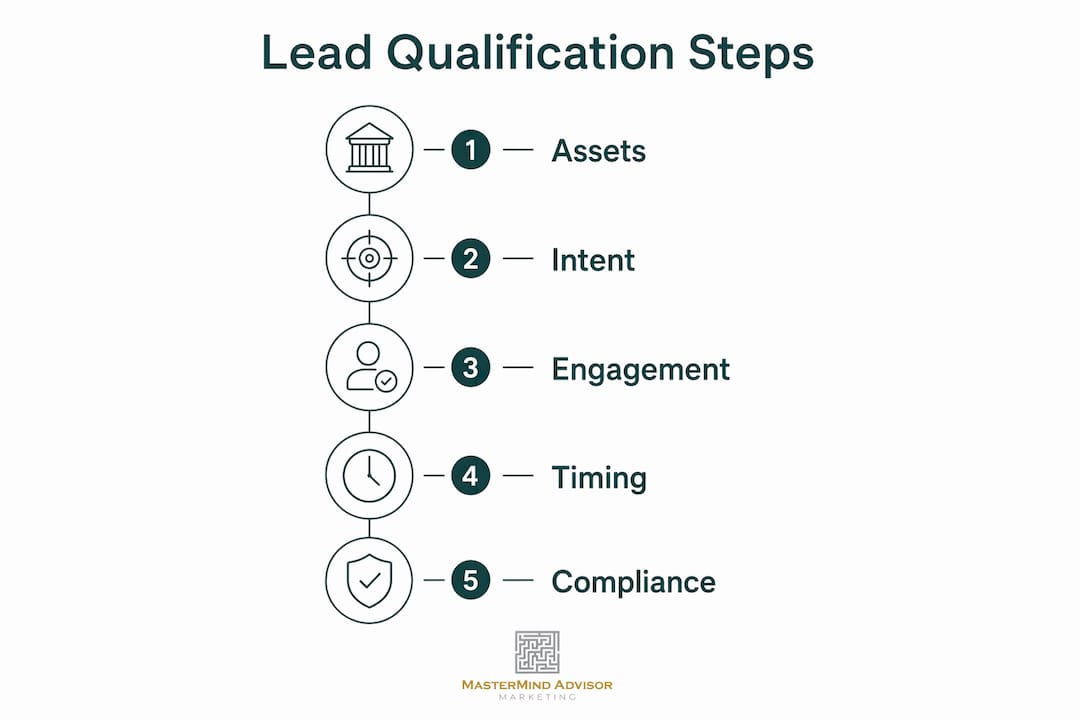
The specific asset threshold varies by niche. An advisor focused on pre-retirees in suburban markets may set the floor at $300,000. An advisor serving tech executives may require $750,000 or more. What matters is that the threshold is defined before campaigns launch, not after, so that marketing spend targets the right audience from the start.
Key qualification signals to track include:
- Asset indicators: Self-reported income ranges, job titles associated with high compensation, or responses to pre-qualification survey questions on landing pages.
- Intent signals: Content downloads, webinar registrations, consultation requests, and email click-through patterns that suggest active research.
- Planning triggers: Life events like retirement within five years, a recent business sale, an inheritance, or a divorce proceeding.
- Engagement depth: Prospects who attend a full webinar and then download a follow-up guide are significantly more qualified than those who open a single email.
Adjusting qualification thresholds requires careful iteration. Tightening criteria increases conversion rates but reduces total lead volume, which can starve the pipeline. Loosening criteria increases volume but wastes advisor time on prospects who will never convert. The right balance depends on your capacity for nurturing and the average revenue per client in your practice.
Pro Tip: Run a quarterly audit of your last 20 converted clients. Identify which intent signals they showed before booking a discovery call. Use that pattern to refine your qualification scoring model, not industry averages.
Navigating regulatory compliance: SEC Marketing Rule and its impact on lead generation advisors
The SEC Marketing Rule 206(4)-1 governs all investment adviser marketing communications and requires firms to adopt written policies and procedures that objectively prevent violations. This rule directly affects every lead generation asset an advisor creates, including landing pages, lead magnets, email sequences, testimonials, and endorsements.
The compliance requirements that most directly affect lead generation include:
- Written approval workflows: Every marketing asset, from a webinar registration page to a downloadable guide, must go through a documented review and approval process before it goes live.
- Substantiation requirements: Any performance claim, client outcome reference, or statistical assertion in marketing materials must be backed by documented evidence that can withstand regulatory scrutiny.
- Testimonial and endorsement rules: Client testimonials and third-party endorsements are now permitted under the updated rule, but they require specific disclosures and cannot be cherry-picked to create a misleading impression.
- Record-keeping obligations: All marketing communications must be retained for a minimum period and be retrievable for examination.
"SEC investigators will expect investment advisers to have proactive, objective, and testable compliance controls in place to prevent marketing rule violations." — Barnes & Thornburg
Advisor marketing materials like landing pages, lead magnets, and endorsing testimonials must have compliance workflows to avoid risks and last-minute campaign disruptions. The practical consequence is that advisors who build their lead generation systems without compliance infrastructure will face either regulatory exposure or the need to rebuild campaigns from scratch after a compliance review. Building the workflow correctly from the start is far less expensive than fixing it under pressure.
Effective lead generation strategies and technology tools for independent financial advisors
The most productive lead generation strategies for financial advisors combine referral networks with scalable digital marketing, supported by technology that automates the repetitive work. Neither approach alone is sufficient. Referrals produce high-quality leads but are unpredictable in volume. Digital marketing produces consistent volume but requires qualification and nurturing investment to convert.

A 2025 Broadridge and FSI survey found that 76% of advisors agree better technology tools significantly improve new client acquisition, but 68% lack confidence in their current tech environment. That gap between desire and confidence is the single biggest obstacle to effective lead generation for independent advisors. Technology does not replace strategy, but it does make consistent execution possible at a scale that manual processes cannot match.
| Strategy | Best use case | Technology required |
|---|---|---|
| Referral program | High-quality leads from existing clients | CRM tracking, referral landing page |
| Educational webinars | Warm prospects at scale | Webinar platform, email automation |
| Gated content offers | Top-of-funnel lead capture | Landing page builder, CRM integration |
| LinkedIn outreach | Professional niche targeting | LinkedIn Sales Navigator, CRM |
| Email nurture sequences | Long-cycle prospect engagement | Marketing automation platform |
Efficient lead nurturing automation helps advisors move prospects from interest to conversion while minimizing manual outreach effort and improving scalability. Tools like HubSpot, Redtail CRM, and Wealthbox each offer advisor-specific features for lead scoring and pipeline tracking. The choice of platform matters less than the consistency of the process built on top of it.
Over 80% of advisors surveyed say education improves their ability to drive business growth. This finding confirms that technology adoption without training produces little return. Advisors who invest in learning their CRM and automation tools, not just purchasing them, see measurably better acquisition results.
Pro Tip: Before adding a new tool to your stack, map the specific funnel stage it addresses. If you already have a CRM but no email automation, add automation next. Buying a second CRM before building a nurture sequence is the most common and most expensive mistake independent advisors make.
Building and measuring a successful lead generation pipeline for your advisory practice
A measurable pipeline is the difference between a practice that grows predictably and one that lurches between feast and famine. The core metrics every advisor should track are conversion rate by funnel stage, average time in each stage, total pipeline value, and cost per acquired client.
Tracking these numbers reveals bottlenecks that are otherwise invisible. An advisor who sees strong lead capture but low qualification rates has a targeting problem. An advisor with strong qualification but low conversion rates has a nurturing or sales process problem. The data tells you where to fix the system, rather than leaving you to guess.
Practical steps for building a measurable pipeline include:
- Define stage entry and exit criteria in writing. A prospect enters the qualification stage when they complete a pre-qualification form. They exit when they book a discovery call. Without written criteria, pipeline data is meaningless.
- Review pipeline metrics monthly, not quarterly. Monthly reviews catch bottlenecks before they compound. Quarterly reviews often reveal problems that have already cost three months of pipeline health.
- Use a referral program framework alongside digital channels. Referral leads typically convert at higher rates and in shorter timeframes than cold digital leads, which improves overall pipeline velocity.
- Segment your pipeline by lead source. Webinar leads, referral leads, and organic search leads behave differently. Tracking them separately shows which channels produce the highest lifetime value clients, not just the most conversions.
Treating lead generation as a funnel with KPIs per stage means that delays in qualification or nurturing become visible problems with identifiable solutions, rather than vague feelings that "leads aren't coming in." That shift in perspective is what separates advisors who scale from those who plateau.
Key takeaways
Lead generation advisors build structured, compliant client acquisition systems that combine targeted marketing, qualification frameworks, and technology automation to produce predictable practice growth.
| Point | Details |
|---|---|
| Four-stage funnel | Prospecting, qualification, nurturing, and conversion each require distinct KPIs and consistent execution. |
| Qualified lead criteria | Prospects with $250K to $500K in investable assets and clear intent signals are the standard qualification benchmark. |
| SEC compliance is non-negotiable | Written approval workflows and substantiation requirements apply to every marketing asset, including landing pages and email sequences. |
| Technology confidence gap | 76% of advisors want better tools, but 68% lack confidence in their current setup, making training as critical as adoption. |
| Measure every stage | Monthly pipeline reviews by funnel stage reveal bottlenecks that quarterly reviews miss entirely. |
Why most advisors get lead generation wrong before they even start
I have worked with enough independent advisors to see the same pattern repeat: they invest in a new tool or tactic, see no results in 60 days, and conclude that lead generation does not work for their practice. The real problem is almost never the tactic. It is the absence of a system around the tactic.
The compliance piece is where I see the most avoidable damage. Advisors build a beautiful webinar funnel, drive traffic to it, and then get flagged by their compliance officer because the landing page copy was never reviewed. The campaign goes dark, the momentum dies, and the advisor walks away convinced that digital marketing is not worth the trouble. Building the compliance workflow first, before the campaign launches, is not bureaucratic overhead. It is the foundation that lets everything else run without interruption.
The other pattern I see constantly is advisors who chase the newest channel instead of mastering the one they already have. LinkedIn, webinars, SEO, paid ads, referral programs: each one works. None of them work if you switch before the current channel has had enough time and consistency to produce data. I tell advisors to pick two channels, build a compliant system around each, measure for six months, and then decide what to change. That discipline is rarer than it should be, and it is the single biggest predictor of whether a practice grows or stagnates.
The advisors I have seen build the strongest practices are not the ones with the most sophisticated technology. They are the ones who know their numbers, follow up consistently, and treat every prospect interaction as a data point in a system they are always refining. That mindset, more than any specific tool or tactic, is what makes lead generation work.
— Josh
How Mastermindadvisormarketing supports your lead generation system

Mastermindadvisormarketing is built specifically for independent financial advisors who want a complete, compliant lead generation system without building it from scratch. The platform provides customized webinar and seminar programs, advisor-specific landing pages, automated email nurture sequences, and a CRM designed around the financial advisor client acquisition cycle. Every component is built with compliance in mind, so your campaigns launch without the last-minute compliance scrambles that derail most advisor marketing efforts. Advisors who want to see exactly how the system works can explore the full platform and review the tools available for every stage of the funnel.
FAQ
What do lead generation advisors do?
Lead generation advisors build and manage the systems that attract, qualify, and convert prospective clients for financial advisory practices. Their work spans digital marketing, CRM management, compliance workflows, and nurture automation.
How long does lead generation take for financial advisors?
The client acquisition cycle for financial advisors typically spans 3 to 18 months from first contact to signed engagement, depending on the prospect's planning urgency and the advisor's nurturing consistency.
What qualifies as a lead for a financial advisor?
A qualified lead is generally a prospect with $250,000 to $500,000 in investable assets who has taken a measurable intent action, such as downloading a guide, attending a webinar, or requesting a consultation.
Does the SEC Marketing Rule affect lead generation campaigns?
Yes. SEC Marketing Rule 206(4)-1 applies to all adviser marketing communications, including landing pages, email sequences, and lead magnets, requiring written approval workflows and substantiation for all claims.
What technology do financial advisors need for lead generation?
Advisors need a CRM with lead scoring, an email automation platform, and a landing page builder at minimum. Tools like HubSpot, Redtail CRM, and Wealthbox each address different parts of the acquisition funnel, and technology education is as critical as the tools themselves.
Recommended
Originally published at source.