
Discover how audience targeting transforms financial advisory practices. Learn to build, test, and measure effective strategies tailored to clients.
Audience Targeting for Financial Advisors: Build, Test, Measure
Audience targeting for financial advisors means selecting a specific group of prospects based on shared financial needs, life stage, or behavior, then delivering messages built for that group rather than everyone. Start today by pulling your top 100 CRM contacts and grouping them by a common financial problem — retirement timing, equity compensation, or business succession. That single exercise, done in 30 minutes, is the foundation of every campaign in this article. What follows is a step-by-step workflow, advisor-ready segment examples, measurement guidance, and compliance guardrails you can apply immediately.
Key Takeaways
Audience targeting works for financial advisors because specificity creates relevance, and relevance is what converts a prospect into a scheduled consultation.
| Point | Details |
|---|---|
| Start with your CRM | Pull your top 100 contacts, tag by financial problem, and build your first segment before buying any new data. |
| Layer targeting types | Demographic data alone is too blunt; add behavioral or intent signals to identify prospects actively seeking help. |
| Test one segment at a time | Run each segment for at least 90 days and track cost per qualified lead, not just clicks or impressions. |
| Match attribution to your sales cycle | Use a 90-to-180-day conversion window and track assisted conversions to see the full path from ad to client. |
| Mastermindadvisormarketing | Provides a turnkey system covering CRM segmentation, compliance-reviewed content, webinar funnels, and automated nurture for independent advisors. |
Table of Contents
- What audience targeting means for financial advisors — and why it changes your business
- The six targeting types every advisor should understand
- Where your audience data actually comes from
- Advisor audience segments you can test this week
- How to build, test, and iterate your targeted campaigns
- KPIs and attribution: what to track and how to judge success
- Regulatory and privacy guardrails U.S. advisors must follow
- Common mistakes advisors make with audience targeting
- How a turnkey targeting system produced measurable advisor leads
- What most advisors get wrong about audience targeting
- Mastermindadvisormarketing builds the targeting system so you can focus on clients
- Sources
What audience targeting means for financial advisors — and why it changes your business
Audience targeting is the practice of dividing a broader prospect pool into smaller groups based on demographics, interests, behavior, or intent, then running campaigns built specifically for each group. For advisors, the outcome is concrete: fewer unqualified leads, higher conversion rates, and clients who arrive already aligned with your service model.
The business case is direct. When you speak to a pre-retiree with $750k in a 401(k) about sequence-of-returns risk, that message lands. The same message sent to a 35-year-old tech employee with RSUs lands nowhere. Adobe's overview of audience targeting confirms that segmenting prospects into groups based on explicit criteria produces higher relevance and better campaign ROI — which, for advisors, translates to higher-quality leads and more efficient marketing spend.
Four concrete benefits advisors see when they move from broad outreach to targeted campaigns:
- Time efficiency. You stop spending hours on prospects who will never convert because they were never a fit.
- Higher AUM per client. Segments built around wealth thresholds or life events naturally attract clients with more complex, higher-value needs.
- Better referrals. Clients who feel you understand their specific situation refer people exactly like themselves.
- Improved compliance controls. Narrower, defined audiences make it easier to review and approve messaging before it goes out.
Michael Kitces argues that a "minimum viable audience" — a very specific, narrow group — typically produces deeper relevance and higher engagement than trying to reach a mass audience. That principle is the engine behind every tactic in this article.
The six targeting types every advisor should understand
Not all targeting works the same way, and the right type depends on what you know about your prospects and where they spend time. Here is a compact taxonomy with advisor-specific examples for each.
| Targeting Type | What It Uses | Advisor Example | Best Use Signal |
|---|---|---|---|
| Demographic | Age, income, occupation, marital status | Women ages 40–52 | Strong when life stage drives the financial need |
| Geographic | ZIP code, metro, state | Suburban ZIP codes near corporate campuses | Ideal for in-person seminars or local SEO |
| Psychographic | Values, risk tolerance, lifestyle | Conservative investors who prioritize legacy | Useful for messaging tone and content format |
| Behavioral | Past actions, content consumed, purchase history | Prospects who downloaded a retirement checklist | High intent; best for retargeting and email nurture |
| Intent | Active search signals, keyword behavior | People searching "when to take Social Security" | Highest conversion potential; use for paid search |
| Lookalike | Similarity to existing best clients | Meta or LinkedIn audiences mirroring your top 20 clients | Scales proven segments; test against first-party control |
A few practical notes on when each type helps versus when it wastes budget:
- Demographic targeting alone is too blunt for advisors. A 55-year-old can be a pre-retiree with $2M or a gig worker with no savings. Layer it with behavioral or intent signals.
- Psychographic data is hard to source directly but surfaces through qualitative interviews and survey responses. It sharpens messaging, not audience size.
- Lookalike audiences on Meta or LinkedIn are powerful for scaling, but Google's documentation on platform audiences makes clear they require a clean seed list and proper setup to perform reliably. Build the seed from your CRM, not a purchased list.
Audiense's blueprint for high-converting audience targeting recommends bundling interest signals with behavioral triggers — a useful frame for advisors who want to move beyond age and income alone.
Where your audience data actually comes from
Most advisors already have better data than they realize. The gap is usually organization, not volume.
First-party data is what you own: your CRM, website analytics, email engagement history, and event attendee lists. This is your highest-quality source because it reflects real interactions with real prospects. Fields that matter most for segmentation include age range, employer or industry, assets under discussion, life event (divorce, inheritance, business sale), and how the contact entered your pipeline.

Second-party data is another organization's first-party data shared directly with you — a strategic partner's client list, a CPA firm's referral network, or a co-hosted webinar attendee list. It is more reliable than purchased data and often more relevant.
Third-party data comes from data brokers and list vendors. It is the least reliable and carries the most compliance risk, particularly under CCPA/CPRA for California residents. Use it to test hypotheses, not to build your core audience.
Platform audiences — Google, Meta, LinkedIn — sit in a category of their own. LinkedIn's job-title and company-size filters are particularly useful for reaching executives, business owners, and professionals with equity compensation. Meta's interest and behavioral layers work well for life-stage segments. Practitioners recommend combining CRM analytics and behavioral tracking with qualitative methods like client interviews to surface the motivations behind financial decisions, which sharpens both targeting and messaging.
Pro Tip: Enrich your CRM affordably before spending on third-party lists. Tools like Clearbit or ZoomInfo can append employer, title, and estimated income to existing contacts. A 500-contact CRM with good enrichment outperforms a 5,000-contact purchased list with no context.
Advisor audience segments you can test this week
These eight segments are ready to use. Each one includes a quick reason it is worth targeting, where to find those prospects, and a one-line message to test.
-
Pre-retirees with $750k+ in investable assets (ages 55–65). The highest-intent segment in financial services. Find them via LinkedIn job titles (senior director, VP, partner) combined with age targeting, or through Google search ads on retirement-planning keywords. Message: "You've built the wealth. Let's make sure it lasts 30 years."
-
Tech employees with RSUs or stock options. Equity compensation creates a specific, time-sensitive problem. Target by employer (major tech companies) on LinkedIn or by interest in equity compensation on Meta. Message: "Your RSUs vest in 90 days. Here's what most tech employees get wrong about the tax hit."
-
Small business owners with 1–10 employees. Business succession, SEP-IRA setup, and key-person insurance are common pain points. Find them through LinkedIn company-size filters or local Chamber of Commerce lists. Message: "Your business is your biggest asset. Is it part of your retirement plan?"
-
Recently widowed individuals. A high-need, high-trust segment. Findability is lower — this group is best reached through referral networks (estate attorneys, grief counselors) rather than paid ads. Message: "You shouldn't have to figure out the financial side alone."
-
Women approaching mid-career (ages 40–52). Women outlive men statistically and often have different risk profiles and planning gaps. Target via LinkedIn by title and age, or Meta by interest in financial independence. Message: "Women retire with less. Here's how to close the gap before 55."
-
High-net-worth families managing generational wealth transfers. Estate planning, trust structures, and charitable giving are the entry points. Find them through estate attorneys and CPAs as referral partners, or via LinkedIn targeting of family office professionals. Message: "Transferring wealth to the next generation takes more than a will."
-
Corporate executives with deferred compensation plans. NQDC plans create specific distribution and tax-timing decisions. Target by job title (C-suite, SVP) on LinkedIn. Message: "Your deferred comp payout is coming. The timing decision matters more than most advisors admit."
-
Young professionals with student debt and early savings (ages 28–38). Lower AUM now, but high lifetime value if you build the relationship early. Find them via Meta interest targeting or content marketing through financial planning blogs. Message: "You can pay off debt and invest at the same time. Here's the order that works."
Findability varies sharply across these segments. Tech employees with RSUs and corporate executives are the easiest to reach with paid targeting because their professional identity is public on LinkedIn. Recently widowed individuals and HNW families are harder to reach through ads and respond better to referral-based outreach and content marketing strategies that build trust over time.
Kitces' 10-factor niche framework — which evaluates segments on urgency, profitability, findability, and advisor fit — is a useful filter before you commit budget to any of these.
How to build, test, and iterate your targeted campaigns
This workflow runs from data audit to measurable result. Follow the steps in order the first time; after that, you will loop between steps 5 and 7 continuously.
-
Data audit. Pull your CRM. Identify your top 20 clients by AUM or revenue. Note what they have in common: age range, employer type, life event that triggered the relationship, how they found you.
-
Segment definition. Choose one segment to test first. Write a one-sentence description: who they are, what financial problem they have, and why they would choose you. Avoid segments broader than "executives" — that is a market, not a segment.
-
Messaging hypothesis. Write one headline and one value statement for the segment. State the specific problem, the specific outcome, and why your approach fits. This is your test creative.
-
Audience build. Upload your CRM seed list to LinkedIn or Meta. Apply platform filters (age, title, employer, interest) to match your segment definition. For Google, build a remarketing audience from website visitors who viewed relevant pages, using Google Analytics audience setup as your technical reference.
-
Campaign setup. Run one ad set per segment. Keep the offer consistent (a webinar, a checklist, a free consultation) so you are testing the audience, not the offer, in round one.
-
A/B testing. In round two, hold the audience constant and test two versions of the headline or the visual. For advisor-scale campaigns (budgets under $3,000/month), run each variant for at least three weeks before drawing conclusions. Smaller budgets need longer windows to accumulate statistically meaningful data.
-
Learn and iterate. After each test cycle, record what changed, what the result was, and what you will test next. A simple spreadsheet works. The goal is a documented learning log, not a perfect campaign on the first try.
Pro Tip: Hold one variable constant per test. If you change the audience AND the creative at the same time, you will not know which change drove the result. Test audience first, then creative, then offer — in that order.
For timing, seasonal life events create natural campaign windows: tax season for business owners, Q4 for equity-compensation segments with year-end vesting, and January for pre-retirees reviewing their plans.
KPIs and attribution: what to track and how to judge success
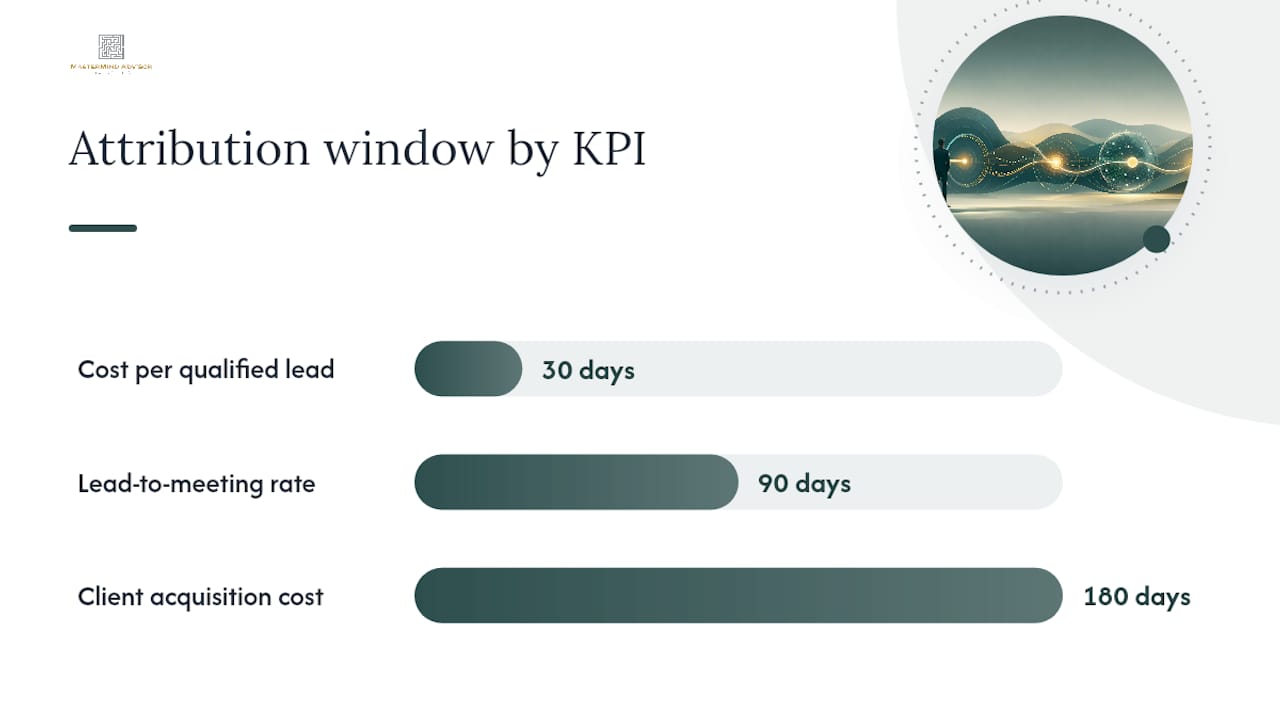
Long sales cycles are the defining measurement challenge for advisors. A prospect who downloads your retirement guide in February may not book a call until July. Standard 30-day attribution windows miss most of that journey.
Primary KPIs:
- Cost per qualified lead (CPQL). Not cost per click, not cost per form fill — cost per lead that meets your segment criteria and takes a second action (books a call, attends a webinar). This is the number that matters.
- Lead-to-meeting conversion rate. Of the leads who enter your funnel, what percentage become a scheduled consultation? Benchmark this against your historical average before targeting, then track improvement.
- Client acquisition cost (CAC). Total marketing spend divided by new clients acquired in a period. Segment-specific CAC tells you which audiences are actually profitable.
- Client lifetime value (LTV). Higher-AUM segments typically have higher LTV. Track LTV by segment origin to confirm your targeting is attracting the right clients, not just more clients.
Secondary engagement metrics: email open rate by segment, webinar attendance rate, content download rate, and time-on-page for segment-specific landing pages.
| KPI | Measurement Cadence | Attribution Window | Action Trigger |
|---|---|---|---|
| Cost per qualified lead | Weekly | 30-day click, 7-day view | Pause if CPQL exceeds 3x target for 3 weeks |
| Lead-to-meeting rate | Monthly | Full funnel (90 days) | Investigate messaging if rate drops 20% month-over-month |
| Client acquisition cost | Quarterly | 180 days | Reallocate budget away from segments with CAC above LTV threshold |
| Email engagement by segment | Weekly | Session-based | Rewrite subject lines if open rate falls below 20% |
Pro Tip: Use UTM parameters on every campaign link and connect them to your CRM. This is the only way to attribute a closed client back to the specific ad, audience, and message that started the relationship. Digital marketing analytics consistently show that advisors who track multi-touch attribution make better budget decisions than those relying on last-click alone.
For attribution, use a 90-to-180-day conversion window for advisor services. Track assisted conversions in Google Analytics — the touchpoints that appeared before the final conversion — because they reveal which content and channels are warming prospects even when they are not the last click.
Regulatory and privacy guardrails U.S. advisors must follow
Targeting the right audience with the wrong message, or the right message through the wrong channel, creates regulatory exposure. These are the guardrails that matter most.
FINRA and SEC messaging rules:
- All advisor communications, including digital ads and social posts used for targeting, are subject to FINRA Rule 2210 (for broker-dealers) and SEC marketing rules (for RIAs). Ads must be fair, balanced, and not misleading.
- Testimonials and endorsements in ads require specific disclosures under the SEC's updated marketing rule. If your lookalike audience campaign uses a client success story, confirm the disclosure language with your compliance officer before launch.
- Retain records of all digital advertising content and targeting parameters. FINRA and SEC examiners have requested social media and digital ad records in recent examinations.
TCPA (Telephone Consumer Protection Act):
- If your campaign drives prospects to a form that triggers an automated text or call sequence, you need prior express written consent before sending those messages.
- Purchased lists carry the highest TCPA risk because you cannot verify how consent was obtained. Stick to opt-in forms with clear consent language for any automated outreach.
CCPA/CPRA (California Consumer Privacy Act / California Privacy Rights Act):
- If you use third-party data lists that include California residents, you must honor opt-out requests and provide a clear privacy notice.
- Advisors using Meta's or Google's platform audiences should review those platforms' data-use policies and confirm their own privacy policies disclose the use of third-party cookies and tracking.
| Regulation | What It Covers | Practical Action |
|---|---|---|
| FINRA Rule 2210 | Broker-dealer advertising content and approval | Pre-approve all ad copy through your compliance workflow |
| SEC Marketing Rule | RIA testimonials, endorsements, performance claims | Add required disclosures to any social proof in ads |
| TCPA | Automated calls and texts to prospects | Collect written consent before triggering automated outreach |
| CCPA/CPRA | Data privacy for California residents | Update privacy policy; honor opt-out requests from third-party lists |
This section is general information, not legal or compliance advice. Confirm current rules with a qualified compliance attorney or your firm's compliance officer before launching campaigns.
Common mistakes advisors make with audience targeting
Most targeting failures trace back to one of five predictable errors.
-
Confusing a target market with a niche. "Executives" is a market. "Female executives at healthcare companies navigating deferred compensation and early retirement" is a niche. The first produces generic messaging that resonates with no one. The fix: write your segment description in one sentence. If it could describe millions of people, it is still a market.
-
Over-segmentation that fragments budget. Running eight simultaneous campaigns with $300 each produces no segment with enough data to learn from. The fix: start with one or two segments, spend enough to get 50+ leads per segment per month, then expand.
-
Ignoring first-party CRM signals. Advisors often spend on new audience tools while their CRM holds 300 contacts with no tags, no life-event notes, and no engagement history. The fix: spend two hours tagging your existing contacts before buying new data.
-
Using poor proxies for intent. Age and income are demographic facts, not intent signals. A 60-year-old with $1M may be fully satisfied with their current advisor. The fix: layer in behavioral signals — content downloads, webinar attendance, search behavior — to identify people actively looking for help.
-
Avoiding niching because it feels like leaving money on the table. This is the most common emotional barrier. The practical rule: test a niche for 90 days before deciding it does not work. Most advisors who abandon niching do so after two weeks, which is not enough time for a long-sales-cycle service to show results.
Audience identification guidance consistently points to the same root cause: advisors skip the research phase and jump straight to ad setup, which means they are targeting assumptions rather than evidence.
How a turnkey targeting system produced measurable advisor leads
One independent RIA came to Mastermindadvisormarketing with a common problem: a CRM full of contacts with no consistent segmentation, a generic newsletter going to everyone, and no clear picture of which marketing activity was producing qualified prospects.
The process started with a CRM data audit that identified two high-value segments: pre-retirees aged 58–65 with employer-sponsored retirement plans, and small business owners who had recently sold or were planning to sell a business. Separate webinar funnels were built for each segment, with messaging and content specific to each group's financial problem. Automated email sequences followed each webinar registration, with content matched to the segment's likely next question.
Tools and capabilities used in the engagement:
- CRM import and contact tagging by segment and life event
- Lookalike audiences on Meta seeded from the top 30 clients in each segment
- Compliance-reviewed ad copy and landing pages
- Automated email nurture sequences with segment-specific content
- Webinar registration and follow-up workflows
Lead volume from the two targeted funnels exceeded the advisor's previous undifferentiated campaigns within the first quarter, with a measurable improvement in lead-to-meeting conversion rate. Specific figures are client-reported and available on request.
What most advisors get wrong about audience targeting
The conventional wisdom says audience targeting is primarily a technology problem — get the right platform, the right data feed, the right automation tool, and the leads will follow. That framing is wrong, and it leads advisors to spend on tools before they have done the thinking that makes tools useful.
The real work is upstream: deciding who you actually want to serve, writing a message that speaks directly to their specific situation, and being willing to say no to prospects who do not fit. Technology executes that decision. It does not make it.
There is also a timing trap advisors fall into. They run a targeted campaign for three weeks, see modest results, and conclude that niching does not work for their practice. Advisory services have long sales cycles. A prospect who attends your webinar in March may not be ready to move assets until September. Measuring a targeting strategy on a 30-day window is like judging a crop after one week of growth.
The advisors who get the most from audience targeting are not the ones with the most sophisticated tools. They are the ones who picked a specific segment, built a message that genuinely fits that segment's problem, and ran the campaign long enough to learn from it. Mastermindadvisormarketing's turnkey system is built around that sequence — advisor positioning strategy first, then the tools to execute it.
Mastermindadvisormarketing builds the targeting system so you can focus on clients
Independent advisors who want to run segment-specific campaigns face a real operational problem: building the CRM tags, the webinar funnels, the compliance-reviewed content, the email sequences, and the attribution tracking takes time most advisors do not have.
Mastermindadvisormarketing's turnkey system handles the full workflow described in this article. CRM integration and contact segmentation, compliance-friendly ad copy and landing pages, fully produced webinars matched to your target segments, automated email nurture sequences, and campaign measurement are all included. The system is built specifically for independent financial advisors and RIAs, which means the content, the compliance workflow, and the audience-build process are already calibrated for the regulatory environment you operate in.
If you are ready to move from a generic newsletter to a targeted campaign that speaks directly to your best prospect segments, schedule a strategy call with Mastermindadvisormarketing to see how the system maps to your practice.
Sources
- Standing out on social media: Minimum viable audience for financial advisors
- What is Audience Targeting? How It Works & Why It Matters
- What is audience targeting and its benefits?
- About audiences - Google Analytics
Recommended
Originally published at source.