
Discover what a boutique advisory firm is and how it benefits RIA owners. Get insights on compliance, niche positioning, and client relationships.
What Is a Boutique Advisory Firm? A Guide for RIA Owners

A boutique advisory firm, in the context of independent wealth management, is a small, privately held registered investment advisor (RIA) that serves a selective client base under a fiduciary standard. These firms typically register with the SEC or their state regulator, file a Form ADV disclosing fees and conflicts, and operate without the product-sales pressure that shapes advice at larger institutions. For an RIA owner evaluating marketing partners, that structure matters: your compliance obligations, your niche positioning, and your trust signals all shape what a marketing vendor can and cannot do for you.
Table of Contents
- What defines a boutique advisory firm?
- How boutique RIAs structure their fees
- What to look for when vetting a marketing vendor
- Realistic timelines and cost ranges for marketing engagements
- How focused marketing actually plays out: two examples
- Key Takeaways
- Why boutique positioning is worth protecting
- Mastermindadvisormarketing builds marketing systems for boutique RIAs
- Useful sources and regulatory references
What defines a boutique advisory firm?
Boutique RIAs range from solo practitioners to teams of roughly 50 people. Most run lean, with a flat org chart where a principal or founding partner stays directly involved in client relationships. That is not a limitation; it is the model. Clients pay for access to the decision-maker, not a junior associate.
Service scope typically spans financial planning, investment management, and tax-aware planning. Some firms add family office-lite services for high-net-worth households. What separates a boutique from simply a small firm is intentional client selection. A boutique turns away clients who do not fit its model. A small firm often cannot afford to.
Niche focus is where boutiques generate their sharpest marketing leverage. Common specializations include a specific profession (physicians, tech executives, federal employees), a life stage (pre-retirees, recent widows), or a tax situation (business owners with concentrated stock). According to Financial Planning, many successful RIAs find growth through niche focus, though selecting a niche too early or one that lacks scale can hurt startups. The practical lesson: let your best existing clients reveal the niche before you build a campaign around it.
- Firm size: solo to ~50 people, principal-led
- Service set: financial planning, investment management, tax-aware planning, sometimes family office–lite
- Client selection: deliberate, often capacity-capped
- Fee transparency: published or clearly disclosed, not buried in product margins
Pro Tip: Before briefing any marketing vendor, write one sentence describing your ideal client by profession, life stage, and financial situation. If you cannot do it in one sentence, the niche is not tight enough to market effectively.
How boutique RIAs structure their fees
Fee structure shapes your entire marketing message. The model you use determines who your ideal client is, what problem you solve for them, and what language converts in a campaign.
AUM percentage: The most common model at boutique RIAs. Fees typically run in a range from roughly 0.50% to 1.25% annually, often tiered by asset level. Marketing language centers on ongoing relationship value and long-term wealth outcomes. The implicit promise: your interests and mine are aligned.
Flat fee and advice-only: A growing segment, particularly among fee-only fiduciary practices. Clients pay a fixed annual or quarterly retainer regardless of portfolio size. This model attracts high-income earners who are still accumulating assets and do not yet have investable assets to justify AUM pricing. Marketing language shifts toward planning depth and accessibility.
Hourly: Less common at boutiques but useful for project-based engagements (divorce financial planning, pre-retirement analysis). Hourly engagements rarely anchor a firm's marketing, but they can serve as a low-barrier entry point.
Hybrid models: Some RIAs combine advisory fees with commissions on insurance products. Disclosure is non-negotiable here. Form ADV must describe every compensation arrangement, and your marketing cannot obscure the dual-compensation structure.
How fee model shapes campaign messaging:
- AUM model: lead with relationship continuity and fiduciary alignment
- Flat-fee model: lead with planning access and transparency
- Hybrid model: lead with comprehensive planning, but disclose compensation clearly in every channel
See the independent advisor service model guide for a deeper breakdown of how service structure affects client lifecycle and retention messaging.
What to look for when vetting a marketing vendor
Most marketing agencies do not understand RIA compliance. That gap creates real regulatory risk. Before signing anything, run this checklist:
Vendor checklist:
- Documented process for SEC-aware content review
- Demonstrated ability to read and align with Form ADV Part 2A
- Compliance review workflow before any asset goes live
- No performance claims that violate the Marketing Rule
- Data security practices covering client and prospect data
Questions to ask every vendor:
- Show me a compliant testimonial or case study you produced for an RIA.
- How do you handle content that references performance or returns?
- Who owns the creative assets at the end of the engagement?
- What KPIs do you report, and how often?
- Can you provide two RIA client references?
Red flags: vague measurement ("we'll grow your brand"), no compliance workflow, cookie-cutter website templates with no ADV alignment, and refusal to share work samples or references.
Evaluate deliverables against lead quality, not vanity metrics. Page views and social impressions do not pay for your associate advisor. Booked consultations do. See top financial advisor marketing agencies for a breakdown of what full-service RIA marketing engagements typically include.
Pro Tip: Ask the vendor to walk you through how they would handle a prospect who asks about your investment performance on a landing page. Their answer tells you immediately whether they understand the Marketing Rule.
Realistic timelines and cost ranges for marketing engagements
| Deliverable | Typical Timeline | Ballpark Cost Range | Key Cost Driver |
|---|---|---|---|
| Advisor website (new build) | — | — | Compliance review, custom copy |
| Webinar funnel (end-to-end) | 4 weeks | — | Production quality, list acquisition |
| Seminar campaign (in-person) | — | — | Venue, direct mail, compliance |
| 12 month content program | Ongoing | — | Volume, SEO depth, review cycles |
A few notes on these ranges. Compliance review adds time and cost to every deliverable. Skipping it to save money is how firms end up with a deficiency letter. Retained engagements (monthly) typically move faster than project-based work because the vendor already understands your ADV and your niche. The cheapest option almost never includes compliance-ready assets. Budget for quality at the front end; rework costs more.
Marketing automation strategies for small firms can reduce ongoing costs once the initial funnel is built, particularly for email nurturing sequences that run without manual intervention.
How focused marketing actually plays out: two examples
Example 1: A two-advisor RIA specializing in pre-retiree federal employees ran a six-week webinar campaign targeting a specific federal agency's workforce. Starting point: roughly four inbound inquiries per month. Tactic: a niche webinar on FERS pension optimization, promoted through LinkedIn and a targeted email list, followed by a five-email drip sequence. Outcome: 14 qualified consultation requests in the first 60 days, with six converting to clients within 90 days. The firm added a part-time client service associate to handle onboarding volume.
Example 2: A solo RIA focused on tech-sector employees with equity compensation built a 12-month content program around RSU taxation and concentrated stock strategies. Starting point: almost entirely referral-dependent, with no digital presence. Tactic: eight long-form blog posts, a LinkedIn publishing cadence, and a lead magnet (an RSU tax checklist). Outcome: organic search traffic generating roughly eight qualified leads per month by month nine, with a cost-per-lead well below what paid advertising would have produced.
What both examples share: A tight persona, a specific pain point, a compliant offer, and a CRM to track every lead from first touch to signed agreement.
Both firms also integrated their marketing with a CRM before launching, so no lead fell through the cracks. See independent advisor case studies for additional real-world growth examples from boutique practices.
Key Takeaways
A boutique RIA's fiduciary structure, niche focus, and Form ADV disclosures are not just compliance requirements — they are the foundation of every credible marketing message you will ever send.
| Point | Details |
|---|---|
| Boutique RIA definition | A small, independent, fiduciary-registered advisory firm serving a selective, niche client base. |
| Compliance comes first | Every marketing asset must align with your Form ADV; mismatches create regulatory and trust risk. |
| Niche focus drives growth | 82% of top-performing RIAs document personas and 86% maintain formal value propositions before launching any campaign. |
| Outsource strategically | Boutiques compete with larger firms by using third-party vendors for tech, compliance, and marketing. |
| Mastermindadvisormarketing | Offers a turnkey, compliance-aware marketing system built specifically for boutique RIAs and independent advisors. |
Why boutique positioning is worth protecting
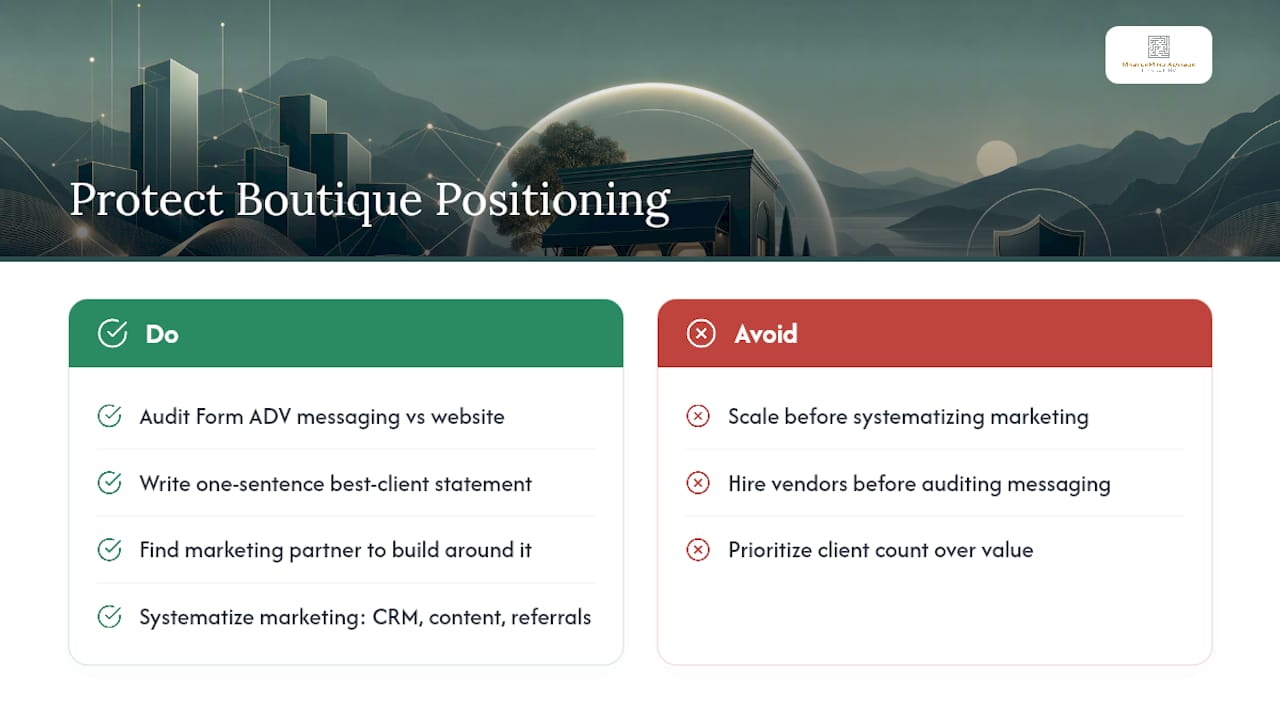
The conventional wisdom says boutique firms need to grow into mid-size firms to survive. I disagree. The boutique model is not a phase; for many advisors, it is the destination. A firm that serves 50 high-value relationships with a tight value proposition and a documented marketing system will often outperform a 200-client generalist practice on every margin metric that matters.
What owners underestimate is how much leverage comes from getting the marketing infrastructure right before scaling. Most boutiques I see try to grow first and systematize later. That sequence is backwards. A CRM that tracks every prospect, a compliant content library that answers your ideal client's real questions, and a referral system with actual structure — those are not luxuries for firms that have already grown. They are what makes growth possible.
The first step is not hiring a vendor. It is auditing your Form ADV messaging against your website, writing one honest sentence about who your best client is, and then finding a marketing partner who can build around that. The advisor positioning strategy guide is a useful starting point for that audit.
Mastermindadvisormarketing builds marketing systems for boutique RIAs
Independent advisors who want qualified leads without building a marketing department from scratch have a direct path: Mastermindadvisormarketing's turnkey system covers the full stack — compliance-aware webinars and in-person seminar campaigns, a content library reviewed for SEC Marketing Rule alignment, automated email drip sequences, scheduled social media content, and high-converting advisor websites integrated with a custom CRM.

Every engagement starts with a Form ADV review and persona mapping session, so the marketing reflects what your firm actually does and who it actually serves. No generic templates, no performance claims that create compliance exposure. The case-study repository shows real outcomes from boutique practices that have used the system to move from referral-dependent to a consistent pipeline of qualified consultations. See how it works at Mastermind Advisor and book a discovery call to review your current marketing against the compliance and lead-quality benchmarks that matter.
Useful sources and regulatory references
Verifying the facts in this article takes minutes with the right primary sources. Here is where to look:
- What a Registered Investment Advisor (RIA) Does: Definition, Duties, Benefits
- What Is a Registered Investment Adviser (RIA)? | AdviceOnly
- What Is an Independent RIA?
- How can new RIAs find their niche
- The consolidation contradiction
- Plans, value props and personas make the difference for top RIA firms
- Marketing growth for financial advisor prospects (Kitces)
- Independent financial advisor or big firm?
| Source | Best Used For |
|---|---|
| SEC IAPD database | Verifying any RIA's registration, ADV, and disciplinary record |
| Form ADV Part 2A | Checking fee disclosures, conflicts, and business practices |
| Kitces.com | Practitioner-level research on advisor business models and marketing |
| Investment News research | Industry benchmarks on firm growth and marketing strategy |
| Financial Planning magazine | Niche strategy, practice management, and regulatory updates |
This article is general information for educational purposes. Confirm current registration requirements, marketing rules, and compliance obligations with the SEC, your state regulator, or a qualified compliance professional.
Recommended
Originally published at source.