
A buyer's guide for advisors to choose compliance-first, turnkey outsourced marketing with a 90 day launch plan and monthly budgets from $2,000–$10,000+.
Advisors: Compliance First Outsourced Marketing Delivers in 90 Days

For most independent advisors who want steady growth without hiring in-house, a fractional CMO or a turnkey outsourced marketing system built around compliance is the fastest path to reliable leads. Start with a short internal audit of what you already have, then request a 90-day plan from a provider that specializes in advisors. That single step separates firms that get a real pipeline from firms that get another vendor invoice.
TL;DR:
- Outsourced advisor marketing systems should integrate content, paid media, social, webinars, email nurture, CRM, and compliance workflows, not just isolated services.
- Engaging a fractional CMO or full-service agency typically costs $4,000 to $10,000+ monthly, with visible results usually appearing within six months.
- Advisors should prioritize vendors with documented compliance processes and references, and negotiate clear asset ownership, KPIs, and termination terms upfront.
- A turnkey, advisor-specific system built around the firm's client profile generally outperforms generic agencies, especially when automation connects all funnel stages seamlessly.
- Firms must first define their ideal client profile and internal ownership structure before outsourcing to ensure tailored, effective marketing execution.
Table of Contents
- What Does Outsourced Advisor Marketing Actually Cover?
- Fractional CMO, Full-Service Agency, or Something Else?
- What Should You Budget, and When Will You See Results?
- How Do You Vet an Outsourced Marketing Partner?
- Compliance and the SEC Marketing Rule: Who Owns What?
- What Happens in the First 90, 180, and 365 Days?
- Why a Turnkey, Advisor-Specific System Often Wins
- Is Your Firm Actually Ready to Outsource?
- How Does Outsourced Marketing Work With Your In-House Team?
- How Do You Protect Client Data With an Outside Marketing Partner?
- Full Outsource or Hybrid? A Practical Take
- Ready for a Turnkey System Built for Advisors?
- Where to Go for Regulatory and Compliance Details
- Sources
- FAQ
What Does Outsourced Advisor Marketing Actually Cover?
Outsourced advisor marketing is the practice of hiring an external team to plan, produce, and manage the marketing functions an advisory firm needs but doesn't have the staff, time, or specialized skill to run well internally. That includes everything from writing blog posts to running paid ads to building the CRM sequences that turn a webinar sign-up into a booked meeting.
Most independent advisors don't need one service. They need several working together, and that's where DIY efforts tend to fall apart: a great website with no lead follow-up, or a strong email list with no compliance record behind it.
Here's the core service set advisors typically outsource, and what each one is actually supposed to produce:
- Content and SEO — Blog posts, guides, and site structure that get found in organic search, reflecting the role of AI in content strategy and SEO success and modern search optimization techniques. This builds long-term equity, not overnight leads. The role SEO plays for advisors has shifted as AI search tools now pull answers directly from well-structured advisor sites, not just link lists.
- Paid acquisition — Search and social ads that fill the top of the funnel fast. Quick to turn on, but the leads stop the day you stop paying.
- Social media management — Scheduled, compliance-reviewed posts that keep a firm visible between bigger campaigns. Slow-burn brand equity more than a lead source.
- Webinar and seminar programs — Structured events, often the single highest-converting activity in the advisor marketing stack, because attendees self-select for interest and then sit through 45 minutes of your expertise.
- Email automation and nurture — Drip sequences that follow up with prospects who aren't ready to meet yet. This is where most advisors leak leads: someone downloads a guide, gets no follow-up, and forgets the firm exists within a week.
- Websites and content management — A site built to convert visitors into booked calls, not just look professional.
- CRM integration — Connecting the website, email tool, and calendar so a lead doesn't require six manual steps to reach a meeting.
- Compliance workflows — Preapproval, recordkeeping, and disclosure processes baked into every piece of content before it goes live.
Some of these produce results inside weeks. Paid ads and email nurture sequences against an existing list can generate booked meetings almost immediately. Others, like SEO and content marketing, build compounding value that takes months to show up but keeps paying off long after a campaign ends. A good digital lead strategy usually blends both: something fast to build momentum, something slow to build a moat.
The mistake most firms make is outsourcing pieces instead of the system. You hire a freelance writer for blog posts, a separate agency for ads, and handle email yourself. Nobody owns the full funnel, and leads fall through the cracks between vendors.
Fractional CMO, Full-Service Agency, or Something Else?
Four engagement models dominate the outsourced advisor marketing space, and picking the wrong one is the most common reason firms feel like they wasted a year of budget.
- Fractional CMO. You get senior marketing strategy and oversight without a full-time executive salary. A fractional CMO builds the plan, sets KPIs, and either manages execution directly or oversees the vendors doing the work. This model closes the gap between strategy and execution that kills so many DIY marketing efforts, because one person is accountable for the whole funnel instead of five contractors pointing fingers at each other. It fits firms with enough AUM to justify $4,000 to $10,000 or more a month, and enough internal maturity to act on strategic recommendations quickly.
- Full-service agency. One vendor executes everything from content to paid media to reporting. You bring the compliance requirements and brand voice; they bring production capacity. This works well for firms that already know what they want done but lack the bandwidth to do it, and it usually runs on a monthly retainer rather than per-project billing.
- Niche specialist. A firm that does one thing extremely well, seminar production, SEO, or paid search, and nothing else. Specialists deliver tactical depth that generalist agencies often can't match, but you're back to managing multiple vendors unless you also have someone internal stitching the pieces together.
- Hybrid model. Templates, playbooks, and brand guidelines stay with the advisor; execution gets outsourced. This is increasingly popular among mid-sized firms that want control without the overhead of building an internal team, and it tends to cost less than a full CMO engagement while still centralizing ownership better than piecemeal outsourcing.
Firm size and AUM matter more than most advisors expect when picking between these. A solo practitioner under roughly $75 million in AUM often gets more value from a focused, done-for-you lead program, SEO, content, one paid channel, and a webinar cadence, than from a heavyweight CMO engagement they don't yet have the pipeline to fully utilize. Scale into the fractional CMO model once your process is proven and the volume justifies the cost.
Contract structure varies by model too. Fractional CMO and full-service agency work is almost always retainer-based, typically with a 90-day or six-month minimum so the vendor has runway to show results. Niche specialist work is more often project-based: a seminar series, a website rebuild, a defined SEO sprint. Read the termination clause before you sign either kind. A retainer with a 30-day out is a very different commitment than one that locks you in for a year.
What Should You Budget, and When Will You See Results?
Realistic cost bands break into three tiers. Marketing augmentation, adding a specialist to support an existing internal effort, typically runs $2,000 to $5,000 a month. A focused lead-generation program combining content, SEO, and one paid channel usually lands between $4,000 and $10,000 or more a month. Full outsourced CMO engagements with execution built in can run higher still, often structured as a retainer plus project fees for major deliverables like seminar series or website rebuilds.
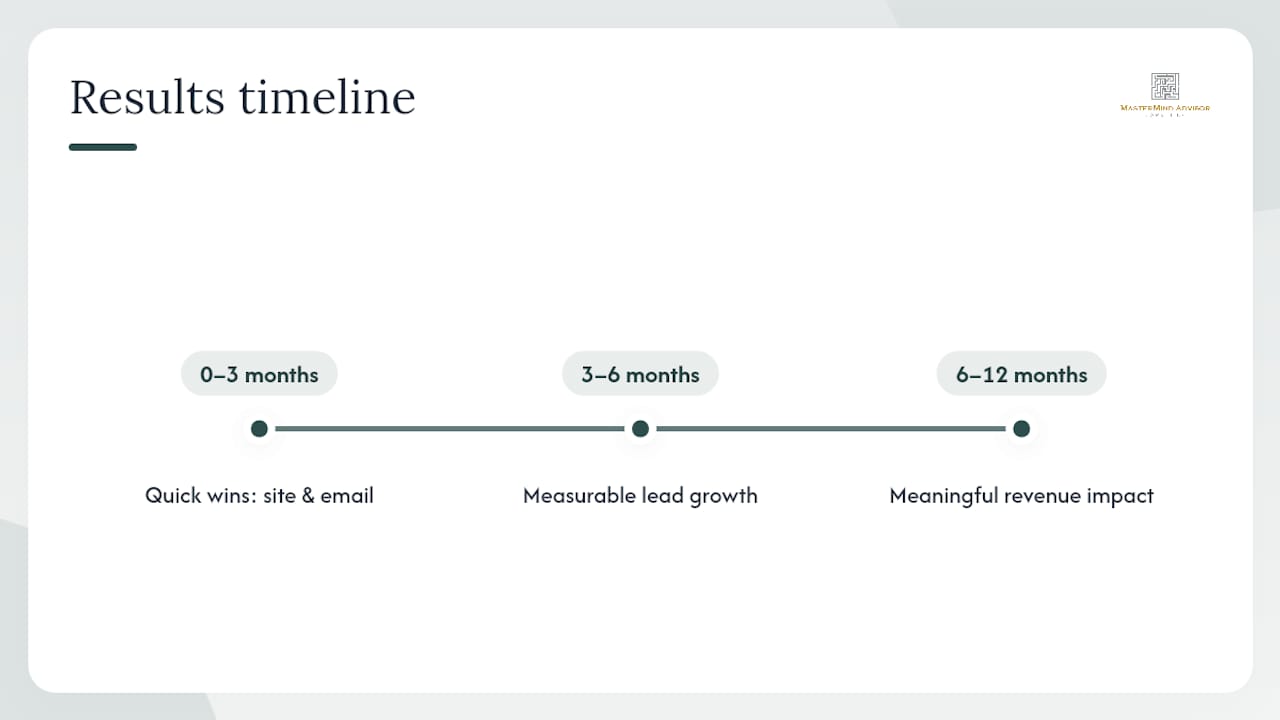
Timeline expectations matter as much as budget. Coordinated outsourced programs typically follow a predictable arc: quick wins inside 3 months (site fixes, email nurture sequences going live), measurable lead growth in 3 to 6 months, and meaningful revenue impact in the 6 to 12 month range as the pipeline matures and the sales cycle for financial advice, often long by nature, plays out.
Statistic to know: Firms that avoid presenting hypothetical performance data under the SEC Marketing Rule make up roughly 39% of advisories, and most that do use it restrict it tightly to one-on-one conversations or unsolicited requests. That caution shapes what any marketing partner can promise you about campaign performance too. If a vendor guarantees a specific return, ask how they'd defend that claim under an SEC exam.
Here's a simple way to estimate payback before you sign anything: take the number of qualified meetings a program is realistically expected to generate per month, multiply by your historical prospect-to-client conversion rate, then multiply by your average client's lifetime value. If a program costs $6,000 a month and is projected to produce 8 qualified meetings converting at 25%, that's 2 new clients a month. Compare that math against your actual average client value before agreeing to any number a salesperson gives you on a discovery call.
One hidden cost rarely makes it into these calculations: the advisor's own time. Running marketing internally, even part-time, pulls hours away from client work and business development, and fragmented vendor relationships often widen the gap between strategy and execution rather than closing it.
How Do You Vet an Outsourced Marketing Partner?
The vetting call matters more than the sales deck. Ask these questions directly and pay attention to how specific the answers are.
- Do you have direct experience marketing for financial advisors, or are we your first?
- Walk me through your compliance preapproval process, step by step.
- Who owns the website, content library, and creative assets if we part ways?
- Can you show me a sample 90-day plan, not a template, an actual example?
- What's your reporting cadence, and what metrics show up on that report?
- Can I talk to two current advisor clients you're actively working with?
Red flags show up fast if you're listening for them. A provider with no documented compliance workflow is a liability waiting to surface in your next exam. One that can't name a single outcome metric beyond "brand awareness" doesn't have a way to prove they're working. No references, or references that turn out to be case studies with no advisor willing to talk, means you're the test case. And if asset ownership is vague in the contract, walk away; you don't want to rebuild a website and content library from scratch because a vendor relationship ended.
The KPI and SLA conversation deserves its own line item in any proposal review:
| KPI | What good looks like |
|---|---|
| Lead quality | Percentage of leads matching your target client profile (AUM, life stage) |
| Cost per meeting | Total spend divided by qualified meetings booked, tracked monthly |
| Meeting to close rate | Percentage of booked meetings that convert to new clients |
| Reporting frequency | Monthly at minimum, with a quarterly strategy review |
Pro Tip: Put asset ownership, termination terms, and a defined 90-day deliverable list directly into the contract language, not in a side email. Verbal promises about "you'll own everything" mean nothing if the master services agreement says otherwise.
Negotiate on three things before you sign: who owns the content and website if you leave, what triggers a termination without penalty, and what proof of results the vendor is contractually required to show you each quarter. A provider confident in their process won't flinch at any of these.
Compliance and the SEC Marketing Rule: Who Owns What?
The SEC Marketing Rule (Rule 206(4)-1) sets the framework every outsourced marketing partner has to build around, covering testimonials, endorsements, third-party ratings, and performance advertising. Any vendor who treats this as your problem to solve alone isn't equipped for advisor marketing.
The rule requires clear and prominent disclosures when using testimonials or endorsements, written agreements with promoters in most cases, and specific conditions before performance results can be shown. Enforcement attention hasn't slowed down. A December 2025 Risk Alert flagged recurring failures around disclosure language and due diligence on third-party ratings, which means 2026 exams are likely to keep testing marketing practices closely.
Here's what operational controls should look like in practice:
- Preapproval workflows — Every piece of content, especially anything touching testimonials or performance, gets compliance sign-off before it publishes, not after.
- Audit trails — A documented record of who approved what and when, stored somewhere you can retrieve it in an exam request.
- Promoter agreements — Written contracts with anyone endorsing the firm, meeting the rule's specific terms.
- Clear and prominent disclosures — Not buried in footer text nobody reads.
The best outsourced partners treat compliance as part of the creative workflow itself, not a gate that slows everything down after the content is finished. That framing matters because a vendor who bolts compliance on at the end will eventually ship something that gets flagged, and it'll be your firm's name on the exam letter.
Split responsibilities clearly from day one. The vendor should manage the workflow, the templates, and the recordkeeping system. You, as the advisor, remain responsible for final sign-off on anything that makes a claim about your track record, and for knowing what's published under your firm's name at any given moment. A step-by-step compliance checklist and clear rules around testimonials specifically are worth reviewing before your first vendor call, so you know what to ask for instead of trusting a sales pitch that says "we handle compliance."
What Happens in the First 90, 180, and 365 Days?
Every serious outsourced marketing engagement follows a similar rhythm, and knowing it in advance keeps expectations realistic on both sides.
- Discovery and audit (weeks 1 to 4). The vendor reviews your existing brand, website, CRM setup, current content, and compliance documentation. This is also when they should map your ideal client profile and current referral sources, because a marketing plan built without that context is guessing.
- 90-day launch. Priority channels go live, usually starting with the highest-leverage pieces: a compliance-reviewed website update, an email nurture sequence, and one paid or organic channel running in parallel. A sample campaign runs end to end so you see the full funnel working, and baseline reporting gets established so month four has something to compare against.
- 6 to 12 month scale plan. Content cadence steadies into a predictable rhythm, seminar or webinar programs launch or expand, paid channels get optimized based on real cost-per-meeting data, and the whole system starts running on feedback loops instead of guesses.
- 12 months and beyond. By this point you should have enough data to know which channels actually produce clients versus which just produce activity, and the conversation shifts from "build the engine" to "tune the engine."
Your internal time commitment doesn't disappear just because the work is outsourced. Plan on a weekly or biweekly check-in call, prompt turnaround on compliance approvals (this is often where timelines slip), and staying available for the occasional piece of content that genuinely needs your voice, client stories, market commentary, the things a vendor can't fully write for you. Firms that treat outsourcing as "set it and forget it" tend to get worse results than firms that show up consistently for the 30 minutes a week it actually requires.
Why a Turnkey, Advisor-Specific System Often Wins
Generic marketing agencies know marketing. They usually don't know the advisor buying cycle, the compliance stakes, or why a prospect who downloaded a retirement guide in March might not book a call until September. That gap is exactly why turnkey systems built specifically for financial advisors tend to outperform generalist alternatives on both speed and safety.
Some marketing providers are built and staffed by people with practicing-advisor backgrounds, which can change what the marketing actually looks like. Webinars get built around the objections advisors hear on real discovery calls, not generic sales funnels borrowed from e-commerce playbooks. Seminar programs follow formats that have already been tested in front of real prospective clients, and seminar calendars get planned around when advisors actually get booked meetings, not arbitrary marketing calendars.
The core value in a system like this isn't any single tactic. It's the wiring between the pieces: content library, CRM automation, and email follow-up connected end to end so a lead that shows interest in October doesn't vanish because nobody followed up in November.
Advisory firms consistently underestimate how much lead volume they're losing to disconnected systems, not lack of interest. The prospect was there. The follow-up wasn't.
Outcomes advisors report include steadier lead flow month over month and less time spent personally chasing compliance sign-off on every social post. Whatever provider you evaluate, ask for the same three things: a sample 90-day plan specific to your firm, a documented compliance workflow you can review before signing anything, and references you can actually call. A partner confident in their process will hand you all three without hesitation.
Is Your Firm Actually Ready to Outsource?
Outsourcing marketing doesn't fix a firm that has no idea who its ideal client is. Before you sign anything, get honest about three things internally.
First, do you know your ideal client profile with any specificity, AUM range, life stage, industry, referral source, or are you still marketing to "anyone with money"? A vendor can execute a plan, but they can't invent your positioning for you. If you can't describe your best client in two sentences, that's homework to do before the discovery call, not during it.
Second, who inside your firm owns the relationship with the marketing partner? Someone needs to approve content quickly, answer strategy questions, and show up to the biweekly call. If that's you and you're already stretched thin during client season, say so upfront so the engagement plan accounts for slower turnaround windows.
Third, what do you already have that's usable? An old website, a stale email list, a CRM nobody updates, none of that has to be perfect, but a vendor needs an honest inventory to plan realistically instead of assuming a clean slate.
Firms that skip this self-assessment tend to blame the vendor six months in for problems that started with unclear internal ownership. A 30-minute internal conversation before the first vendor call saves months of friction later, because the plan gets built around your actual capacity instead of an idealized version of it.
How Does Outsourced Marketing Work With Your In-House Team?
Most advisory firms already have someone touching marketing, an office manager posting on social media, an associate advisor writing the occasional email. Outsourcing doesn't mean replacing that person. It means giving them a clearer lane.
Draw a firm line between strategic and execution work versus relationship-dependent work. The outsourced partner should own content production, campaign execution, CRM automation, and compliance workflow management. Your internal team stays responsible for anything that requires your firm's actual voice: personalized client outreach, real-time responses to market events, and final compliance sign-off on anything bearing your name.
Set one point of contact on each side. Nothing kills a marketing engagement faster than three internal staffers giving a vendor conflicting direction, or a vendor's account team changing without notice. A single owner on your side, even if it's you, keeps decisions consistent and keeps the vendor accountable to one voice instead of a committee.
Weekly or biweekly syncs work better than sporadic check-ins, especially in the first 90 days when the system is still being calibrated. Keep a shared document or dashboard both sides can see, so questions about campaign status don't turn into an email chain nobody has time to untangle.
How Do You Protect Client Data With an Outside Marketing Partner?
Any outsourced marketing partner touching your CRM, email list, or website almost certainly has access to some amount of prospect and client data. Treat that access with the same scrutiny you'd apply to a custodian or a compliance vendor.
Ask upfront where your data lives, who inside the vendor's organization can access it, and what happens to it if the relationship ends. A vendor that can't answer clearly, or that stores your CRM data on a personal account rather than a firm-level system, is a liability regardless of how good their creative work looks.
Get a written data processing agreement or confidentiality clause into the contract, not a verbal assurance. It should cover data retention, breach notification timelines, and explicit language confirming that client and prospect data belongs to your firm, not the vendor, if you part ways. This matters as much as the asset-ownership language covering your website and content library.
Ask specifically how the vendor secures integrations between your CRM, email platform, and website. Weak links usually show up at the connection points between tools, not inside any single platform. A partner who can explain their security practices in plain language, rather than deflecting to "we're compliant," is one worth trusting with sensitive client information.
Full Outsource or Hybrid? A Practical Take
Full outsourcing makes sense when your firm has clear positioning, a defined ideal client, and simply lacks the hours or skill to execute consistently. Hand it over, set clear KPIs, and let the partner run.
Hybrid makes more sense when you have strong opinions about brand voice or client experience that you don't want diluted, or when budget realistically only supports partial support. Keep templates and messaging guidelines in-house; outsource the production grind, the scheduling, the CRM plumbing, the parts that eat time without needing your personal fingerprint.
Either way, three things should be non-negotiable. Require asset ownership in writing, so you're never rebuilding a website or content library from zero if a relationship ends. Demand transparent KPIs reported on a fixed cadence, not vague "brand awareness" updates that can't be measured against a dollar figure. And start with a 90-day experiment before committing to a year-long retainer, because that window tells you more about how a vendor actually operates than any sales call ever will.
One thing I'd protect no matter which model you choose: keep client-facing relationship work internal. Outsource the machinery behind the scenes, the content calendar, the ad management, the email automation, but the actual conversations with prospects and clients should stay yours. Marketing can fill your pipeline. It shouldn't replace the trust that gets built one meeting at a time.
— Josh
Ready for a Turnkey System Built for Advisors?
Some marketing providers exist because generic agencies don't understand the advisor sales cycle, the compliance stakes, or why a prospect from a spring seminar might not convert until fall. These turnkey systems are built specifically to close that gap: customized webinars and seminars, a compliance-friendly content library, automated email drip campaigns, scheduled social content, advisor websites built to convert, and CRM integration that connects every piece so leads stop falling through the cracks between vendors.
This fits best for independent advisors and small RIA practices that want a coordinated pipeline without hiring an internal marketing team, or without stitching together three separate specialist vendors themselves. In discovery, ask for the same things you'd ask any provider: a sample 90-day plan specific to your firm, a documented compliance workflow, and references from advisors actively using the system.
Review the full services lineup, covering webinars, seminars, the content library, email marketing, social media, and website builds, and start the conversation about a growth strategy built around your firm's actual client profile instead of a generic template.
Where to Go for Regulatory and Compliance Details
Before signing with any outsourced marketing partner, review the primary compliance documents directly rather than relying on a vendor's summary of them.
- SEC Final Rule: Marketing by Investment Advisers (Rule 206(4)-1) — the full regulatory text governing testimonials, endorsements, and performance advertising.
- SEC Marketing Rule enforcement in 2026 analysis — coverage of the December 2025 Risk Alert and where enforcement attention is headed.
- Practical compliance checklist for the Marketing Rule — a stepwise breakdown advisors can use to vet a vendor's process.
- Testimonial-specific compliance guide — the three conditions RIAs must meet before using client testimonials.
Sources
- SEC marketing rule is 'challenging' to navigate, say advisors - InvestmentNews
- SEC Final Rule: Marketing by Investment Advisers (Rule 206(4)-1)
FAQ
How Much Does Outsourced Marketing Cost for Advisors?
Costs generally fall into three bands: marketing augmentation runs about $2,000 to $5,000 a month, a focused lead-generation program runs roughly $4,000 to $10,000 or more a month, and full CMO-level engagements often add project fees on top of a retainer. Pricing for specific services like webinars, seminars, and websites is available directly through the provider's services page.
Is Outsourcing Marketing a Dying Concept for Advisory Firms?
No. Demand is shifting toward specialized, compliance-aware providers built for financial services rather than generalist agencies, which is the opposite of outsourcing losing relevance. The firms struggling are the ones treating outsourcing as a single freelance hire instead of an integrated system.
What Does Outsourced Marketing Mean for a Financial Advisory Firm?
It means hiring an external partner, whether a fractional CMO, full-service agency, or niche specialist, to plan and execute marketing functions like content, lead generation, and compliance workflows that the firm doesn't have the internal staff or expertise to run consistently.
What Is a Red Flag for a Financial Advisor Choosing a Marketing Partner?
The biggest red flag is a vendor with no documented compliance preapproval process, since that exposes the firm to real risk under the SEC Marketing Rule. Vague asset ownership terms and an inability to name a single measurable outcome metric are close behind.
How Long Before Outsourced Marketing Shows Real Results?
Expect quick operational wins within 3 months, measurable lead growth within 3 to 6 months, and meaningful revenue impact typically within 6 to 12 months as the pipeline matures and prospects move through a naturally long advisory sales cycle.
Recommended
Originally published at source.