
Learn how to create a financial advisor podcast that converts leads into clients. Discover essential tips for equipment, strategy, and promotion!
You already know your clients need guidance. The harder problem is getting in front of the right people before a competitor does. When you create a financial advisor podcast, you give yourself a recurring presence in your prospects’ lives, one that builds trust before the first phone call ever happens. This article walks you through every stage: the equipment, the content strategy, the production workflow, and the promotion tactics that actually generate clients. No theory. No fluff. Just what works.
Table of Contents
- Key takeaways
- How to create your financial advisor podcast: equipment and planning
- Recording, editing, and producing your episodes
- Promoting your podcast and growing your listener base
- Measuring success and avoiding common mistakes
- My honest take on podcasting for financial advisors
- Ready to launch your financial advisor show?
- FAQ
Key takeaways
| Point | Details |
|---|---|
| Low startup cost | You can launch a podcast for as little as $0 using free hosting and a basic USB microphone. |
| Niche focus drives results | A retirement-focused podcast attracted a specific demographic and generated $130,000 in new client revenue within 12 months. |
| Consistency builds trust | Publishing twice or three times per month is more effective than sporadic high-volume bursts. |
| SEO extends your reach | Pairing podcast episodes with transcripts and FAQ content improves discoverability in AI-driven search results. |
| Clear calls to action convert | Every episode should remind listeners exactly who you serve and how they can work with you. |
How to create your financial advisor podcast: equipment and planning
Before you record a single word, you need two things: the right tools and a clear plan. The good news is that the tools are cheaper than you think.
Equipment and software costs
You do not need a professional studio. A quality USB microphone in the $100 to $200 range gives you broadcast-level audio from your home office. Pair that with free software like Audacity or GarageBand for recording and editing, and your production costs are minimal. For hosting, free podcast hosting platforms exist that distribute your show automatically to major platforms.
Here is a quick comparison of the core tools you will need:
| Tool category | Budget option | Mid-range option |
|---|---|---|
| Microphone | Audio-Technica ATR2100x (~$99) | Shure MV7 (~$249) |
| Recording software | Audacity (free) | Adobe Audition (~$55/mo) |
| Editing software | GarageBand (free, Mac) | Descript (~$24/mo) |
| Podcast hosting | Spotify for Creators (free) | Buzzsprout (~$12/mo) |
| Remote recording | Zencastr (free tier) | Riverside.fm (~$19/mo) |
Defining your niche and audience
This step matters more than any microphone you buy. A podcast called “Financial Advice for Everyone” will attract no one. The advisors who win with podcasting go deep on a specific audience. Think: pre-retirees in their 50s, small business owners navigating exit planning, or physicians managing student loan debt alongside wealth building.
Research confirms that niche-focused content attracts a self-selecting audience that already qualifies itself as your ideal client. That is the opposite of cold outreach.
Pro Tip: Start by writing down the three questions your best clients asked before they hired you. Those questions are your first three episode topics.
Once you have your niche defined, decide on your format. Solo commentary works well for advisors who are comfortable on camera and have strong opinions. Interview formats add credibility through guest expertise. Q&A episodes built around real client questions tend to perform exceptionally well because they mirror exactly what prospects are searching for.

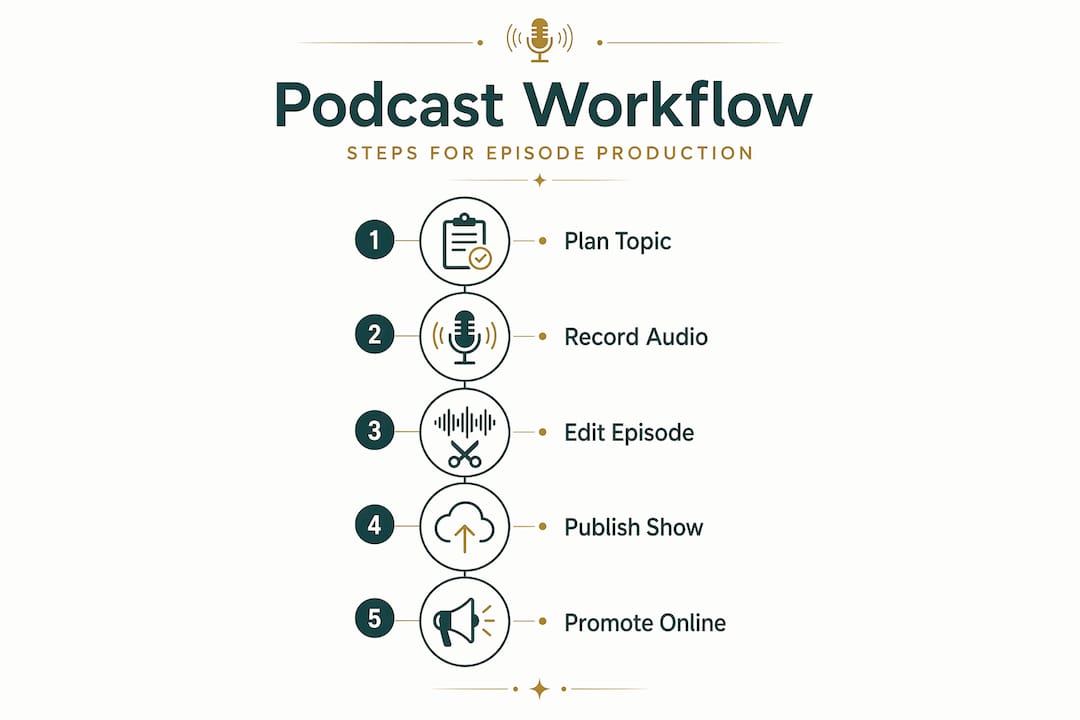
Recording, editing, and producing your episodes
With your plan in place, here is a straightforward production workflow you can repeat for every episode.
-
Write a structured outline, not a full script. A word-for-word script makes you sound stiff. Instead, write three to five bullet points per section with the key idea and one supporting example. This keeps you natural while staying on track.
-
Set up your recording environment. Close the door. Turn off HVAC if possible. Hang a blanket behind you if your room echoes. Small rooms with soft furnishings sound better than large open spaces.
-
Record in short segments. If you stumble, pause for two seconds and repeat the sentence. Those pauses are easy to edit out and far easier than trying to do a perfect single take.
-
Edit for clarity, not perfection. Remove long pauses, repeated filler words like “um” and “you know,” and any tangents that do not serve the listener. You do not need to remove every imperfection. Authenticity matters in a financial advisor show.
-
Brand your audio. Commission a short intro and outro through a freelance platform like Fiverr or Voices.com. Budget $50 to $150 for a professional voice and royalty-free music. This signals credibility from the first five seconds.
-
Publish through Spotify for Creators. Spotify’s free hosting distributes your show automatically to Spotify’s audience of over 100 million podcast listeners. Submit your RSS feed to Apple Podcasts and Google Podcasts separately to maximize reach.
-
Write show notes for every episode. Include timestamps, key takeaways, and a clear call to action. These notes become searchable content that drives organic traffic to your podcast long after the episode publishes.
Publishing frequency matters more than most advisors realize. Twice monthly is a realistic and sustainable starting point. It gives you enough touchpoints to build a relationship without burning you out in month three.
Pro Tip: Batch record two or three episodes in a single sitting. You are already warmed up, the equipment is set, and you protect yourself against missing a publish date when life gets busy.
Promoting your podcast and growing your listener base
Recording great content is half the job. Getting it in front of the right people is the other half. Here is where many advisors stop short, and where you can separate yourself.
-
Optimize every episode for search. Publish a written transcript alongside each episode. FAQ-style podcast content helps AI-driven search engines index your expertise, which means your episodes surface when prospects ask questions on Google, ChatGPT, or Perplexity.
-
Use your email list first. Your existing contacts are your warmest audience. Send a brief email when each episode drops with one sentence on what the listener will learn and a direct link. Keep it short.
-
Appear as a guest on other podcasts. Find shows that serve adjacent audiences, such as small business owners or HR professionals, and pitch yourself as a financial expert. One guest appearance can add hundreds of targeted listeners to your show.
-
Repurpose clips on social media. Pull a 60-second clip from each episode and post it to LinkedIn. Financial advisors who share client-focused audio clips consistently outperform those who only post text updates.
-
End every episode with a clear call to action. Tell listeners exactly who you work with, what problem you solve, and one specific step they can take. “If you are within ten years of retirement and want to review your plan, visit my website and book a 20-minute call” is infinitely more effective than “reach out if you have questions.”
One more thing on tone. Financial advisors who reduce jargon and focus on what genuinely worries their clients connect far more effectively than those who lead with credentials and product descriptions. Talk about the fear of running out of money in retirement. Talk about the stress of a business exit. That is what keeps your listeners coming back.
Pro Tip: Add your podcast link to your email signature with a one-line description. Every client email you send becomes a passive promotion channel.
Measuring success and avoiding common mistakes
Most advisors who launch a podcast and quit within six months make the same handful of mistakes. Here is what to watch for and how to measure whether your show is actually working.
The most common early pitfalls:
- Irregular publishing that breaks listener habit
- Episodes that are too long and unfocused
- Messaging that talks about your services instead of your clients’ problems
- No clear call to action at the end of episodes
- Failing to promote episodes after they publish
For metrics, track downloads per episode, email list growth tied to podcast mentions, and direct inquiries that reference the show. Downloads matter less than conversions. An episode with 200 downloads that generates two discovery calls beats an episode with 2,000 downloads that generates none.
The real benchmark for what is possible comes from a case study worth knowing. A retirement podcast generated $130,000 in new client revenue and 120,000 total downloads within 12 months on an $11,000 marketing budget. The advisor did not have a massive following at launch. She had a specific niche, a consistent schedule, and a show that spoke directly to what her ideal clients were already worried about.
“The podcast worked because it was relentlessly specific. Every episode was for one person: a man in his 50s thinking about retirement and not sure if he was on track.”
Adjust your content regularly based on listener feedback. If you get the same question in three different emails, record an episode answering it. That is your audience telling you exactly what they need.
My honest take on podcasting for financial advisors
I have worked with enough financial advisors to see a clear pattern. The ones who hesitate to launch a podcast usually say one of two things: “I don’t have time” or “I don’t think anyone will listen.” Both concerns are understandable. Neither holds up under scrutiny.
The time issue is real, but it is manageable. A 20-minute episode recorded twice a month takes roughly four hours of total work once you have a system. That is less time than one networking event, and the episode keeps working for you long after you record it.
The “no one will listen” concern is more interesting to me. What I have found is that advisors who say this are usually thinking about podcasting as a mass media play. It is not. You do not need 10,000 downloads. You need 200 listeners who are exactly the kind of people you want as clients. A 2024 marketing strategy that integrates podcasting with your email and social channels compounds that reach significantly.
The advisors I have seen succeed with podcasting share one trait: they are specific. They know who they are talking to, they say it out loud in every episode, and they make it easy for that person to take the next step. Start there. Everything else is refinement.
— Josh
Ready to launch your financial advisor show?
If you have been sitting on the idea of starting a podcast, this is the moment to move. The advisors building authority in your niche right now are not waiting for perfect equipment or a flawless script. They are publishing consistently and learning as they go.
At Mastermindadvisormarketing, we work exclusively with independent financial advisors to build marketing systems that generate real client growth. From content strategy and podcast planning to full-service production support, our team knows what works in this industry because we work in it every day. Explore our advisor marketing services to see how we can help you launch a podcast that builds your practice, not just your download count.
FAQ
How much does it cost to start a financial advisor podcast?
You can launch a podcast for $0 using free hosting platforms and a basic microphone you may already own. A quality USB microphone runs between $100 and $200, making the total startup cost well within reach for most advisors.
How often should a financial advisor publish podcast episodes?
Publishing twice a month is a strong starting point. Increasing frequency to two or three times per month was directly linked to stronger listener relationships and revenue growth in documented advisor case studies.
What topics work best for a financial advisor podcast?
Episodes built around the real questions your clients ask before hiring you perform best. Reducing jargon and focusing on specific client concerns, like retirement readiness or tax planning anxiety, consistently outperforms content that leads with credentials or product descriptions.
How do I get more people to find my financial advisor podcast?
Publish a written transcript with every episode and structure your show notes around FAQ-style content. Transcript-based podcast content is indexed by AI-driven search engines, which significantly increases your discoverability among prospects actively searching for financial guidance.
How long does it take for a financial advisor podcast to generate clients?
Results vary, but a well-executed niche podcast can generate meaningful revenue within the first year. One documented example shows a retirement-focused podcast producing $130,000 in new client revenue within 12 months on a modest marketing budget.
Recommended
Written by admin
Originally published at source.