
Stop optimizing for opens. Use account progression metrics—stage entry, time in stage, and multi threading. See the 90 day advisor pilot.
B2B 6–18 Month Deals: Measure Stage Entry, Not Opens

For long B2B sales cycles, the single most important change is to stop optimizing for opens and start optimizing for account progression using leading indicators. That means measuring stage-entry counts, time-in-stage against an expected curve, and multi-threading depth instead of email engagement. It also means mapping content and outreach to where an account actually sits, not to a generic drip schedule. Everything else in long sales cycle marketing follows from that shift.
TL;DR:
- Tracking stage-entry counts and time-in-stage against expected curves provides early warnings of deal stalls, instead of relying solely on revenue outcomes.
- Building a buying-group map and updating it regularly helps ensure engagement with multiple stakeholders, reducing the risk of losing deals due to personnel changes.
- Content should be tailored to both buyer awareness levels and account progression states, triggered by signals rather than fixed schedules, to stay relevant throughout the extended sales journey.
- Establishing clear signals for handoff and pilot testing small-scale tactics prevent deal drops caused by vague criteria or unproven approaches.
- Measuring early indicators like account movement and engagement offers more actionable insights than traditional metrics like email opens or click rates in long sales cycles.
Table of Contents
- What Defines a Long Sales Cycle (and Why Short-Cycle Tactics Fail)
- What Metrics Actually Predict Progress in a Long Cycle?
- How to Build Content and Nurture Flows for Extended Buying Journeys
- How Do You Build a Buying-Group Map and Multi-Thread an Account?
- Getting the Handoffs and Pilot Rhythm Right
- Common Pitfalls in Long-Cycle Marketing (and Fast Fixes)
- How Mastermind Advisor Marketing Puts This Playbook to Work for Advisors
- What Actually Moves the Needle in a Long Sales Cycle
- A 90-Day Pilot for Advisors Ready to Test This Playbook
- Sources
- FAQ
What Defines a Long Sales Cycle (and Why Short-Cycle Tactics Fail)
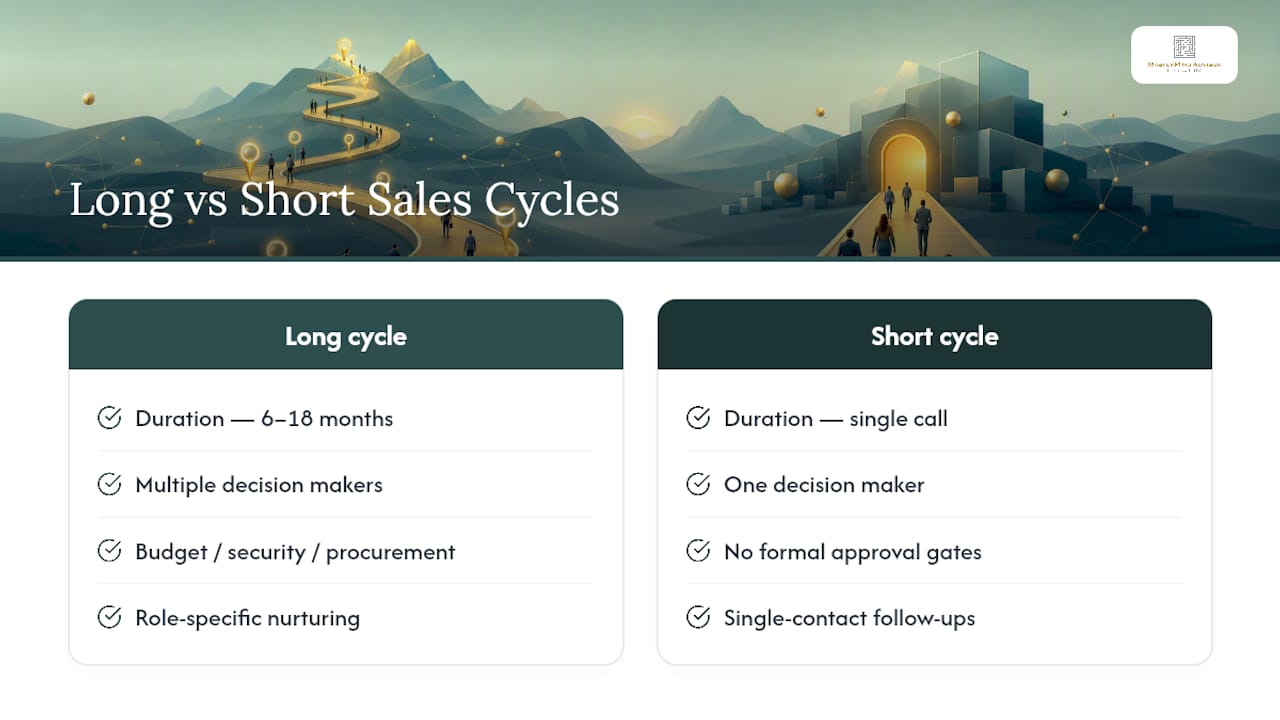
A long sales cycle is any complex B2B purchase that takes six to eighteen months to close, involves multiple decision makers, and passes through formal approval gates like budget review, security assessment, or procurement sign-off. By contrast, a short-cycle transaction is closed by one person in a single call, making it obvious why the same playbook can't cover both.
The complexity comes from people, not calendars. A typical enterprise deal might touch a champion, a budget holder, a technical evaluator, and a legal reviewer, each joining the conversation at a different point. Momentum stalls when one of those stakeholders goes quiet, gets reassigned, or simply forgets why the deal mattered three months after the first demo.
This is where "value between moments" becomes essential. Nurturing has to serve the entire buying committee with role-specific content that helps a champion build an internal case, not just remind a single contact that your company still exists. Effective long-cycle lead nurturing typically spans six to eighteen months and depends on progressive, multi-stakeholder engagement rather than a fixed number of touches. Marketing that treats this like a short funnel with more steps will keep losing deals to silence, not to competitors.
What Metrics Actually Predict Progress in a Long Cycle?
Traditional 90-day attribution models simply can't measure a deal that takes a year to close. By the time revenue shows up, the campaign that influenced it is long forgotten, and the team has no early warning when a deal is quietly dying.
The fix is to track movement and aging, not outcomes. Because outcome metrics arrive too late to act on, teams need weekly counts that flag trouble while there's still time to intervene, according to research on long sales cycle metrics.
Five indicators matter most:
- Stage-entry counts — how many accounts moved into each pipeline stage this week, which shows whether the funnel is actually flowing or just sitting full.
- Time-in-stage vs. expected curve — comparing each deal against its cohort's typical pace, not a single company-wide age cutoff, which avoids flagging a slow-moving enterprise deal as broken when it's simply following a longer curve.
- Cohort conversion rate — tracking how each monthly or quarterly intake group converts over time, which surfaces sourcing or qualification problems months before they show up in closed revenue.
- Multi-threading depth — the number of active stakeholder relationships per account, since single-threaded deals collapse when one contact leaves or disengages.
- Deals with no buyer-driven activity — opportunities where the only movement is coming from your side, a strong signal the deal has gone cold.
Pro Tip: *Run cohort analysis monthly by grading each intake group against its own peers rather than the company average.
Daily dashboards should surface stage-entry and no-activity counts. Weekly reviews belong on time-in-stage and threading depth. Save cohort conversion and closed-revenue analysis for the monthly business review, where trends matter more than noise.
How to Build Content and Nurture Flows for Extended Buying Journeys
Long-cycle nurture only works when content is mapped to two things at once: where the buyer is mentally, and where the account is structurally. Here's a practical build sequence.
- Map assets to five stages of buyer awareness. Unaware prospects need executive point-of-view pieces that name a problem they haven't fully articulated yet. Problem-aware buyers respond to role-specific case studies. Solution-aware and product-aware stakeholders need ROI calculators and implementation roadmaps. Most-aware buyers, usually near a decision, need stakeholder one-pagers and a mutual action plan they can walk into a committee meeting with.
- Map the same content to account progression states. An account in the "cluster" state, meaning multiple people are researching but no one has raised a hand, gets educational content. An account in "active focus," with a named champion engaging, gets tailored ROI modeling. An "engaged" account, deep in evaluation, gets implementation and legal-readiness assets.
- Build trigger logic instead of a fixed calendar. A signal like a new stakeholder viewing a pricing page should trigger a stakeholder one-pager within 24 hours, not wait for the next scheduled email blast. Calendar cadences still work for background nurture, but signal-driven triggers should own the moments that matter.
- Pick channels by intent level. Gated ROI reports and webinars work well for problem-aware and solution-aware accounts. LinkedIn outreach from a named rep works better once a champion has emerged. Email carries the mutual action plan and implementation roadmap once legal and procurement enter the picture.
This structure keeps content relevant across a twelve-month window instead of relying on volume to stay top of mind. Modern B2B marketing for long sales cycles leans on education before conversion and tight alignment with sales rather than a volume-first drip strategy.
How Do You Build a Buying-Group Map and Multi-Thread an Account?
A single relationship is a single point of failure. If your only contact changes jobs, goes on leave, or simply stops replying, the deal doesn't slow down. It disappears.
Buying-group mapping starts the moment an account shows real intent, not after the first call. Build a simple grid of roles (economic buyer, technical evaluator, end user, procurement, legal) against names, and update it every time a new person surfaces in an email thread or meeting invite.
- Identify at least one likely stakeholder per role within the first two weeks of active engagement, even if you haven't spoken to them yet.
- Equip your champion with an internal-selling toolkit, meaning a slide deck and one-pager they can forward without needing you in the room.
- Build a "catch-up" asset specifically for late-joining stakeholders who show up in month eight with none of the earlier context.
- Watch for signals that say "add another stakeholder": a stalled deal, a delayed signature, or a champion who suddenly can't answer budget questions.
- Watch for signals that say "retry a relationship": a dormant contact reappearing in a thread, or a company announcement (new hire, reorg) that changes who holds influence.
Pro Tip: Keep a running one-pager mapped to each role in the buying group. When a new stakeholder joins in month nine, you hand them exactly what they need instead of scrambling to summarize eight months of history in a rushed email.
Getting the Handoffs and Pilot Rhythm Right
Marketing and sales lose the most deals not in the middle of the cycle, but at the handoff points. A vague "marketing qualified lead" definition dumped into a sales queue with no context is where long-cycle deals quietly die.
- Define mechanical handoff signals. A lead moves from marketing to sales only when specific, observable criteria are met, such as two stakeholders engaging with high-intent content or a demo request from a named decision maker, not a subjective "feels ready" judgment.
- Run small pilots before scaling any new tactic. A ten-account pilot focused on account-to-pipeline conversion, rather than volume, proves whether a new nurture motion or trigger actually works before you roll it out company-wide, an approach GTM efficiency guidance for long cycles recommends over broad rollouts.
- Separate weekly operating metrics from quarterly outcome metrics. Weekly counts (stage entries, no-activity flags) tell you if the engine is running. Quarterly metrics like account velocity and pipeline conversion tell you if it's working. Decompose the quarterly forecast by source so you know which motion is actually producing movement.
Aligning CFO and CMO around blended, all-channel attribution makes it far easier to fund a program that won't show revenue for two more quarters, since a shared metric reduces the internal argument over whose numbers count.
Common Pitfalls in Long-Cycle Marketing (and Fast Fixes)
The biggest trap is the illusion of activity. High open rates and click volume rarely translate into pipeline movement in a long cycle. Watch for buyer-driven signals, meaning actions the prospect initiates without prompting, not just responses to your outreach.
- Diagnose stale deals with a 12-month rule. Any opportunity with no meaningful buyer-driven activity in twelve months gets flagged for re-qualification, not left to age quietly in the pipeline.
- Fix cold deals with a re-qualification play. A short call or email that directly asks whether priorities have changed will surface dead deals faster than another drip email.
- Rescue late-stage confusion with an executive catch-up asset. New stakeholders joining mid-cycle need a fast-track summary, not the full nurture sequence from month one.
- Use a mutual action plan template to keep both sides accountable to the same timeline instead of guessing at next steps.
- Archive, don't delete, deals that go fully cold. Keep them in a quarterly re-engagement list rather than nurturing indefinitely or losing the account history.
How Mastermind Advisor Marketing Puts This Playbook to Work for Advisors
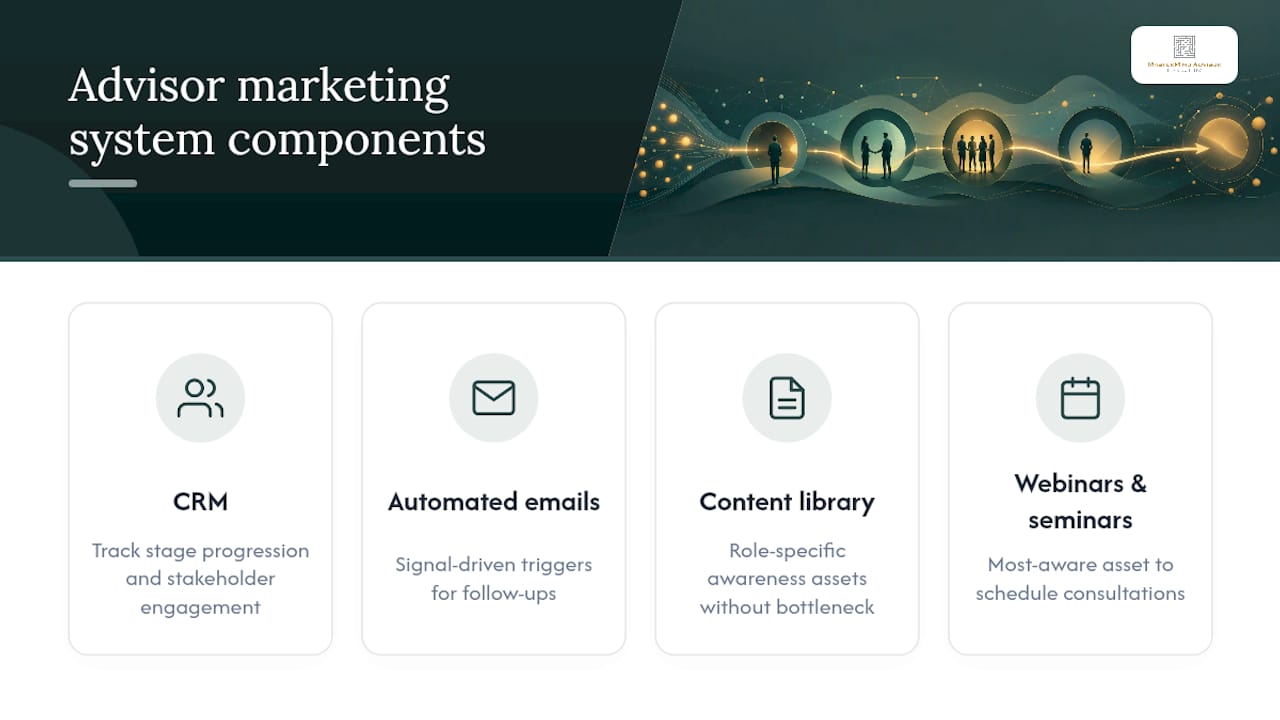
Financial advisory sales cycles are a textbook long-cycle environment: multiple household decision makers, compliance review, and trust built over many months. A turnkey marketing system for financial advisors can be built around similar mechanics. Integrating a CRM can track stage progression and stakeholder engagement instead of vanity opens. Automated email follow-ups can apply signal-driven triggers rather than blind calendar blasts. A compliance-friendly content library can supply role-specific, awareness-stage assets advisors need without a compliance review bottleneck. Webinars and seminars can function as the "most-aware" stage asset, giving advisors a structured way to move a household from consideration to a scheduled consultation.
What Actually Moves the Needle in a Long Sales Cycle
If you take one thing from this guide, make it this: stop measuring what's easy and start measuring what's early. Stage-entry counts and time-in-stage curves feel less satisfying than an open-rate report, but they're the only numbers that give you enough runway to fix a stalling deal before it's dead.
For financial advisors specifically, this matters more than most industries realize, because trust builds slowly and compliance limits how aggressively you can nurture. A system built around account progression, not blast frequency, fits that reality far better than generic marketing automation ever will.
— Josh
A 90-Day Pilot for Advisors Ready to Test This Playbook
Independent advisory practices can put this playbook to work without building the infrastructure in-house. Instead of assembling a CRM, a content library, and a nurture sequence from scratch, or hiring a general marketing agency that treats compliance requirements as an afterthought, advisors can use systems built specifically for the multi-month, multi-decision-maker nature of financial services sales.
A ninety-day pilot is a realistic window to see stage progression and engagement patterns start to shift, not a guarantee of closed business in three months. The pilot scope typically includes a compliance-reviewed content library, an automated follow-up sequence mapped to buyer stage, and a webinar or seminar built to convert engaged households into booked consultations. If you want to see how the pieces fit your practice, visit Mastermind Advisor and request a pilot conversation, or review the 90-day nurture pilot breakdown first to see exactly what gets built before you commit.
Sources
FAQ
What Is a Long Sales Cycle?
A long sales cycle is a B2B purchase process that takes roughly six to eighteen months to close, typically involving multiple stakeholders, formal approval gates, and progressive decision making rather than a single fast transaction.
What Is the 30-60-90 Rule in Sales?
The ramp-up plan for new sales hires usually breaks into learning, contributing, and owning phases spaced across several months, rather than a framework for managing deal length itself.
What Are the Seven Stages of the Sales Cycle?
Most versions of the sales cycle include prospecting, initial contact, qualification, needs assessment, presentation or proposal, handling objections, and closing, though the exact labels vary by organization and industry.
What Is the 2-2-2 Rule in Sales?
Definitions of the 2-2-2 rule vary across sales training programs, and no single canonical version applies universally, so it's worth confirming which framework a specific source or manager means before applying it.
How Does Mastermindadvisormarketing Support Long Sales Cycles for Advisors?
Mastermindadvisormarketing pairs a custom CRM, automated follow-up sequences, and a compliance-friendly content library so advisors can track account progression and nurture households through a multi-month decision process instead of relying on generic drip email.
Recommended
Originally published at source.