
Discover how financial advisors can use evergreen content to generate lasting leads. Create timeless resources that attract clients effortlessly.
Evergreen Content Financial Advisors Use to Compound Leads

Evergreen content is durable, reusable educational material, guides, FAQs, and explainers, that keeps generating leads for financial advisors long after publication, at a fraction of the cost of one-off campaigns. It works because it answers questions people search for regardless of the date: "How does a Roth conversion work?" outlasts "3 market moves to watch this week." The single most useful thing you can do this month is build one pillar asset, a how-it-works article or video, tied to a lead magnet like a downloadable checklist or short assessment.
Before you touch a content calendar, get this one piece right:
- Pick one core client question that never goes stale (retirement income sequencing, fee structures, how RIAs get paid)
- Build a 1,500 to 2,500 word guide or 8 to 12 minute video answering it in full
- Attach a lead magnet (calculator, checklist, or short guide) behind an email capture
- Set a 90 day check-in to see if it's earning organic traffic before you build the next one
TL;DR:
- Creating one in-depth pillar guide or video on a core client question builds a long-lasting asset that attracts organic traffic over time.
- Content should focus on principles and processes, avoiding dates, market levels, or current events to preserve its evergreen relevance.
- Using the F.I.R.E. framework helps select topics that are foundational, insightful, reusable, and engaging to maximize impact and longevity.
- Implementing strict review, documentation, and archiving processes ensures content remains compliant with SEC rules and supports efficient updates.
- A turnkey system with pre-approved templates, automation, and a content library streamlines production, reduces compliance effort, and accelerates sustainable lead generation.
Table of Contents
- What Counts as Evergreen Content for Financial Advisors
- Why Evergreen Content Pays Off for Advisory Practices
- Which Evergreen Formats Actually Work for Advisors
- How to Build Evergreen Content With the F.I.R.E. Method
- How to Distribute and Track Evergreen Content Over Time
- Measuring What Works and Auditing What Doesn't
- SEC and FINRA Rules Your Content Program Can't Ignore
- When and How to Refresh Evergreen Content
- What a Turnkey System Adds to an Advisor's Content Program
- Why Most Advisors Underestimate How Long Evergreen Content Takes to Pay Off
- A Turnkey Way to Put This Into Practice
- Key Takeaways
- Sources
What Counts as Evergreen Content for Financial Advisors
Not everything you publish qualifies as evergreen, and confusing the two is the most common reason advisor content programs stall. Evergreen content answers a question that stays relevant for years: "What is a fiduciary?" "How much should I save for retirement?" "What's the difference between a Roth and traditional IRA?" Timely content, market commentary, quarterly outlooks, reactions to a Fed rate decision, has real value but expires within weeks. Both belong in a marketing plan. Only one builds a compounding asset.
The format you choose determines the shelf life. A quarterly market update written as a blog post is dead the day the next quarter starts. The same insight, reframed as "How Advisors Help Clients Navigate Market Volatility," survives because it's about the principle, not the moment. Pillar pages, long-form guides that fully cover one topic, tend to outlast shorter posts because they capture a broader range of search queries and give you more surface area to link from.
Four rules keep content evergreen rather than perishable:
- Strip dates and numbers that will look wrong in a year (say "recent years" instead of "in 2026" unless the year is the actual subject).
- Write about principles and processes, not current events or specific market levels.
- Anchor claims to timeless mechanics (how compounding works, how tax brackets function) rather than today's rates.
- Build for a recurring question, not a one-time news cycle.
If you're not sure whether a topic qualifies, ask whether someone will still be Googling that exact question in three years. If yes, it's evergreen. If the answer depends on this week's headlines, it's timely content and belongs in a separate channel.
Why Evergreen Content Pays Off for Advisory Practices
The business case for evergreen content comes down to three things: cost, authority, and lead quality, and each compounds over time in a way paid campaigns never do. A one-off webinar ad spends its budget and disappears. A pillar guide keeps earning organic traffic for years after the writing is done, which is exactly why Nasdaq's coverage of evergreen content strategy frames it as a way to lower ongoing marketing spend while building legitimacy with both search engines and prospects.
Search authority is the second lever. Google rewards sites that consistently answer real questions thoroughly, and each well-built page becomes a small vote of relevance that lifts the pages around it. That's compounding in the literal sense: traffic this year makes traffic easier to earn next year.
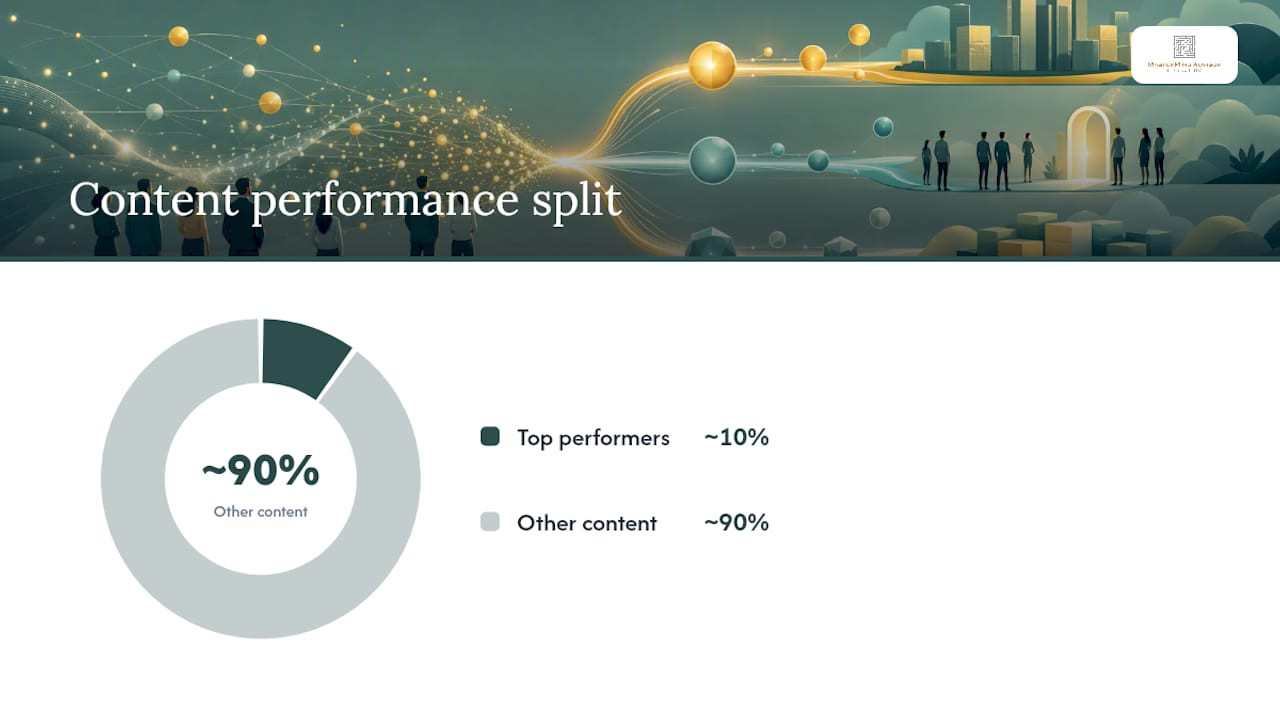
A small share of content drives most results. Research on advisor content performance, documented in Kitces' analysis of evergreen social strategy, shows that roughly 10% of what advisors publish generates the majority of engagement and conversions. That's not a reason to publish less. It's a reason to measure early, identify your winners, and put your energy into repurposing and promoting them rather than constantly generating fresh raw material.
The third factor is lead quality. Financial advice involves long sales cycles, often six to eighteen months of research before a prospect books a call. Evergreen content matches that timeline naturally: a prospect finds your retirement income guide in month one, reads three more pages in month four, and reaches out in month nine already educated about how you work. That's a warmer lead than anything a paid ad delivers cold.
A few reasons this matters more for advisors than for most industries:
- Trust sells financial advice more than urgency does, and evergreen content builds trust passively.
- Compliance review costs the same whether content lives for a month or five years, so durability multiplies the return on that review time.
- Long sales cycles reward content that nurtures prospects automatically between touchpoints.
Which Evergreen Formats Actually Work for Advisors
Pillar guides, FAQs, checklists, client stories, and calculators each serve a different stage of the buyer's research, and picking the wrong format for the job is where most advisor content underperforms. A pillar guide, something like "The Complete Guide to Retirement Income Planning", works because it can rank for dozens of related searches at once and link out to shorter cluster pages that go deeper on subtopics. That internal linking structure is part of why long-tail keyword strategy matters so much for advisor SEO: a single pillar page can capture search traffic a dozen individual blog posts never would on their own.

FAQ pages and how-to explainers punch above their weight because they mirror the exact phrasing people type into Google. "How much do financial advisors charge?" and "What's the difference between fee-only and commission-based advisors?" are evergreen questions that will drive search traffic for as long as the fee models themselves exist.
Client story frameworks add credibility, but they require care. Anonymize identifying details, get written consent, and frame the story around a scenario, not a promise of results, to stay inside the bounds of what regulators consider an acceptable testimonial. A story like "How one pre-retiree restructured a 401(k) rollover to reduce fees" works because it teaches a concept through a relatable arc rather than implying anyone else will get the same outcome.
Interactive tools, retirement calculators, fee comparison tools, risk tolerance quizzes, tend to generate the highest engagement of any format because they give something back instantly. They also carry the highest compliance overhead, since any tool that implies a projected return needs careful disclosure language and a compliance sign-off before it goes live.
Rank these formats by effort versus payoff when you're deciding what to build first:
- Pillar guides: highest effort, highest long-term traffic ceiling
- FAQ pages: low effort, strong match to real search queries
- Client stories: moderate effort, strongest trust-building impact
- Calculators: high effort and compliance review, highest engagement per visitor
How to Build Evergreen Content With the F.I.R.E. Method
Most advisors who abandon content marketing don't quit because the ideas ran out. They quit because there was no repeatable process, so every piece became a fresh negotiation with themselves about what to write and how. A workflow fixes that, and it starts before you write a single word.
Step 1: Define the avatar and the decision moment. Every piece of evergreen content should target one specific type of client at one specific point in their decision process, not "people interested in finance." A pre-retiree wondering whether to delay Social Security thinks differently than a 35-year-old deciding between a Roth and traditional 401(k). Write the content brief around that moment, not around a broad topic.
Step 2: Build the brief before you build the content. A real content brief includes the goal (rank for a keyword, capture emails, support a sales conversation), a substantiation list of every factual claim and its source, compliance notes on what needs disclosure, a specific call to action, and a repurposing plan, because deciding how you'll reuse the asset before it exists saves you from rebuilding it later.
Step 3: Apply the F.I.R.E. framework to topic selection and execution. The F.I.R.E. content method asks four questions of every topic before you commit resources to it:
- Foundational: Does this cover a core concept clients need regardless of market conditions?
- Insightful: Does it say something beyond what a Google search already surfaces?
- Reusable: Can this be cut into five social posts, a newsletter section, and a client email without losing meaning?
- Engaging: Does the opening earn a reader's attention in the first two sentences?
A topic that fails two or more of those checks probably belongs in your timely content bucket, not your evergreen pipeline.
Step 4: Edit, approve, and archive with a checklist, not memory. Before anything publishes:
- Confirm every factual claim has a source in your substantiation file
- Route the draft through your designated compliance reviewer, not an informal "someone glance at this"
- Save the final approved version, the approval date, and the reviewer's name in a permanent archive
- Log the publish date and the planned repurposing schedule in your content calendar
Pro Tip: Build your repurposing plan into the brief, not after publication. Deciding in advance that a pillar guide will become three social posts, one email, and a short video means you shoot the video footage or draft the captions while the topic is still fresh in your head, instead of dreading a repurposing project six months later.
Systemizing this, templated briefs, pre-approved language blocks, standardized archiving, is what separates advisors who publish consistently from those who produce one great guide and go quiet for four months. A documented content strategy gives your team (or your outsourced partner) a process to follow instead of a blank page every time.
How to Distribute and Track Evergreen Content Over Time
Publishing is the easy part. The value in evergreen content comes from feeding it into every channel you have, repeatedly, over years, and from knowing which piece is actually producing leads.
On the SEO side, structure matters more than volume. A pillar page on retirement planning should link out to cluster pages on Social Security timing, required minimum distributions, and healthcare costs in retirement, each targeting a specific long-tail search. That structure, explained well in research on long-tail keyword strategy, tends to outperform a single broad page because it captures dozens of specific searches instead of competing for one crowded term.
For social media, build a library of evergreen posts you can schedule on a recurring cadence rather than writing something new every day. A single pillar guide can become fifteen or twenty social posts spread across months, each pulling a different stat, quote, or subpoint from the original piece.
Email is where evergreen content earns its keep as a nurture engine. A lead magnet tied to your pillar guide feeds into an automated sequence that delivers value over weeks, connecting naturally to how a marketing funnel for advisors should move a cold visitor toward a booked call.
None of this matters without tracking. Consistent UTM tagging on every link, campaign source, medium, and content name, lets you see in Google Analytics exactly which piece of content is producing form fills, following the UTM tracking conventions that keep attribution clean instead of guesswork.
A simple repurposing matrix keeps this organized:
| Original Asset | Repurposed Into | Channel |
|---|---|---|
| Pillar guide (1,500 to 2,500 words) | 4 to 5 social posts | LinkedIn, Facebook |
| Pillar guide (1,500 to 2,500 words) | Short explainer video | YouTube, website |
| Client story | Email nurture sequence entry | |
| FAQ page | Newsletter Q&A segment | |
| Calculator tool | Lead magnet landing page | Paid and organic search |
Measuring What Works and Auditing What Doesn't
Track four numbers and ignore the vanity metrics: organic sessions per page, assisted conversions (did this page appear in the path before someone booked a call), leads produced directly from a page's lead magnet, and average time on page as a proxy for whether people actually read it.
Run a quarterly audit against those numbers with three possible outcomes for every asset:
- Update it if it's ranking but the facts, links, or offers are stale.
- Repurpose it if it's performing well and hasn't been turned into social posts, video, or email content yet.
- Retire or consolidate it if it's getting no traffic after six months and overlaps with a stronger page.
Since roughly 10% of content typically drives most of the results, your quarterly audit's real job is finding that top decile fast. Once you spot it, funnel repurposing effort there first. A guide getting steady organic traffic deserves five more social posts and a video before you write anything brand new.
SEC and FINRA Rules Your Content Program Can't Ignore
Nearly everything you publish as an advisor counts as an advertisement under the SEC's Marketing Rule, including blog posts, videos, and social content, which means compliance isn't a separate step from content creation. It's built into the workflow or the workflow doesn't hold up under exam.
Testimonials and endorsements need specific disclosures: whether the person was compensated, any material conflicts, and, in most cases, a written agreement if a third party is being compensated to promote your practice. Performance statements need net-of-fee context and can't cherry-pick favorable periods. The SEC Marketing Rule compliance guide is explicit that firms need contemporaneous substantiation, meaning you document your basis for a claim at the time you make it, not after an examiner asks.
Recordkeeping under Rule 204-2 means keeping approval logs (who reviewed what and when), substantiation files (the sources backing every factual claim), and final archived versions of everything you publish, even after it's taken down. A practical compliance checklist for advisor marketing should specifically flag misleading claims, testimonial disclosures, and archiving procedures before anything goes live.
The operational fix that actually works: build a library of pre-approved language blocks for common disclosures, standardize your review workflow so every piece goes through the same reviewer in the same order, and use templates for recurring content types (client stories, calculator disclaimers, performance discussions) so your compliance team isn't reinventing the review each time.
- Confirm every advertisement has a named, timestamped reviewer
- Store substantiation for every factual or performance claim before publishing
- Require written agreements for any compensated testimonial or endorsement
- Archive the final published version, not just the draft that got approved
Pro Tip: Keep a single shared document listing every regulatory phrase you're required to use (fee disclosures, hypothetical performance disclaimers, testimonial disclosures) so your team copies pre-approved language instead of drafting new disclosure text from scratch each time. That alone cuts most compliance review cycles in half.
When and How to Refresh Evergreen Content
Evergreen doesn't mean permanent.
A refresh checklist keeps updates fast instead of turning into a rewrite:
- Verify every fact and figure is still accurate
- Check that internal and external links still resolve
- Confirm compliance language matches your current pre-approved templates
- Update the call to action if your lead magnet or offer has changed
Assign one owner, whether that's a marketing coordinator or an outsourced partner, responsible for tracking which pages are due for review and logging the date and outcome of each audit. Without a named owner, refresh schedules quietly die the first time the team gets busy.
What a Turnkey System Adds to an Advisor's Content Program
Advisors who build evergreen content without a system tend to hit the same wall: the first guide takes a month to produce and get through compliance, and by month three, momentum stalls. A structured, documented content strategy with pre-built templates and automated archiving removes most of that friction, because every new piece follows a known path instead of starting from zero.
A content library paired with CRM automation compounds the benefit further. Once a pillar guide exists, an automated email sequence can deliver it to every new lead without a human retyping anything, and repurposed social snippets can post on a fixed schedule instead of depending on someone remembering to do it.
What this looks like in practice for an advisory practice:
- One advisor's retirement income guide, built once, fed a six-month email nurture sequence and a recurring social post cadence without additional writing time
- A compliance-reviewed FAQ library reduced the back-and-forth between a growing advisory team and its outside compliance consultant
- Standardized briefs meant a new team member could produce a compliant draft in their first week instead of needing months of ramp-up
Governance matters as much as production. Someone still needs to own the calendar, the compliance workflow, and the audit schedule, tools reduce the labor, not the accountability.
Why Most Advisors Underestimate How Long Evergreen Content Takes to Pay Off
The biggest misconception I see is advisors expecting evergreen content to behave like paid advertising: publish, wait a week, count leads. It doesn't work that way, and treating it like it should is why so many advisors quit three months in, right before the content would have started earning organic traffic in earnest.
The mistake isn't the content. It's the expectation. A pillar guide typically needs several months to climb search rankings, and the compounding effect Kitces describes with the 10% rule only shows up once you have enough published assets to compare against each other.
My practical advice: commit to a minimum of two full quarters before judging whether a piece is working, and build your first three assets around your most commonly asked client questions, not your most interesting opinions. The boring, obvious question you've answered a hundred times in client meetings is usually your best evergreen topic, because it means a hundred prospects are searching for that exact answer online right now.
— Josh
A Turnkey Way to Put This Into Practice
Building a compliant evergreen content library while running an advisory practice is where most of this plan stalls, not because the strategy is wrong, but because nobody on a small team has the hours to write, repurpose, and track content every week. Mastermind Advisor exists for that exact gap: a turnkey marketing system built specifically for independent financial advisors, with the content library, CRM automation, and compliance-ready workflows already built rather than assembled from scratch.

Three things make it a practical next step rather than another tool to manage:
- A pre-built, compliance-reviewed content library removes the blank-page problem and the reviewer bottleneck
- CRM and email automation deliver your lead magnets and nurture sequences without manual follow-up
- Custom webinars, seminars, and advisor websites plug directly into the same evergreen strategy this article walks through
If you'd rather have this system running in your practice than build it piece by piece, see how Mastermind Advisor works and get a plan mapped to your firm's client base and growth goals.
Key Takeaways
Evergreen content works for financial advisors because it compounds organic leads over years while keeping marginal marketing cost lower than repeated paid campaigns.
| Point | Details |
|---|---|
| Start with one pillar asset | Build a single how-it-works guide or video tied to a lead magnet before expanding your library. |
| Separate evergreen from timely | Keep principle-based content (fiduciary duty, tax mechanics) apart from market commentary that expires in weeks. |
| Follow the F.I.R.E. framework | Test every topic for whether it's foundational, insightful, reusable, and engaging before producing it. |
| Build compliance into the workflow | Log substantiation, reviewer approval, and archived final versions for every asset under the SEC Marketing Rule. |
| Audit quarterly for the top 10% | Identify high-performing content and prioritize repurposing it over creating new raw material. |
| Consider a turnkey system | Mastermind Advisor pairs a compliance-ready content library with CRM automation to scale this process without added headcount. |
Sources
- Scale Social Media Marketing With Evergreen Content
- What Is Evergreen Content and Why Advisors Should Focus On It
- Financial Advisor Marketing Compliance Checklist
- UTM codes guidance for tracking campaigns
Recommended
Originally published at source.