
Learn how to create a financial planning blog that generates leads. Use targeted strategies for content and compliance to boost conversions.
Create a Financial Planning Blog That Generates Leads

Start with a focused ideal client profile, three content pillars, and stage-specific CTAs. That single framework produces predictable, compliant leads from your blog without requiring a marketing team or a massive budget.
Here is the quick-action checklist to launch this week:
- Choose your ICP: demographics, life stage, asset range, and primary financial concern
- Map three content pillars (e.g., retirement planning, tax-aware accumulation, financial life transitions)
- Publish your first evergreen post with a ToFu CTA (newsletter sign-up or free guide download)
- Add email capture to your homepage and post footers via Mailchimp or ConvertKit
- Route captured leads into your CRM (HubSpot works well here) with a Zapier automation
Both the SEC Marketing Rule (Advisers Act Rule 206(4)-1) and FINRA Rule 2210 treat blog content as advertising. Every post needs a compliance review before it goes live. Mastermindadvisormarketing offers a turnkey alternative if you prefer not to build this infrastructure on your own.
Pro Tip: Write your first three posts before you launch the blog. Publishing on day one with a backlog prevents the gap that kills most advisor blogs in month two.
Table of Contents
- What goals and timeline should you set for your financial planning blog?
- How do you define your niche and build content pillars that attract qualified prospects?
- What content formats and CTAs actually convert at each funnel stage?
- What does a compliant pre-publish checklist look like for advisor blogs?
- Which tech tools do you actually need to run an advisor blog?
- How do you build an editorial calendar with a compliance review built in?
- How do you promote posts and turn one article into multiple lead touchpoints?
- When should you scale, A/B test, or bring in outside help?
- What templates can you use right now for posts and CTAs?
- What results have advisors seen with a blog-led approach?
- How do you qualify and nurture leads after initial capture?
- How does CRM integration connect your blog to your sales process?
- What security and privacy rules apply to lead data in financial services?
- How do you analyze competitor blogs to find content gaps?
- How do you make your financial blog accessible and inclusive?
- Key Takeaways
- Why your blog is your digital handshake, not a brochure
- Mastermindadvisormarketing: a done-for-you alternative for advisors who want results without the DIY
- Authoritative references and regulatory resources
What goals and timeline should you set for your financial planning blog?
A financial advisor blog is a long-cycle asset. The financial decision cycle is long, so plan to nurture prospects over months, not days. Set three core KPIs from the start: monthly qualified lead volume, qualified lead conversion rate (lead to discovery call), and cost per qualified lead.

Realistic early targets for an independent advisor running a focused blog include achieving a steady flow of qualified leads monthly by the latter part of the first year, reasonable lead-to-call conversion rates, and a decreasing cost per qualified lead as organic traffic grows.
| Phase | Timeline | Primary Goal |
|---|---|---|
| Setup & compliance alignment | Month 0 | CMS live, compliance workflow documented |
| Content crawl | Months 1–3 | 12 posts published, email list started |
| Funnel optimization | Months 4–9 | MoFu assets live, CRM routing active |
| Scale | Months 10–12 | Paid promotion, webinar funnel, outsource review |
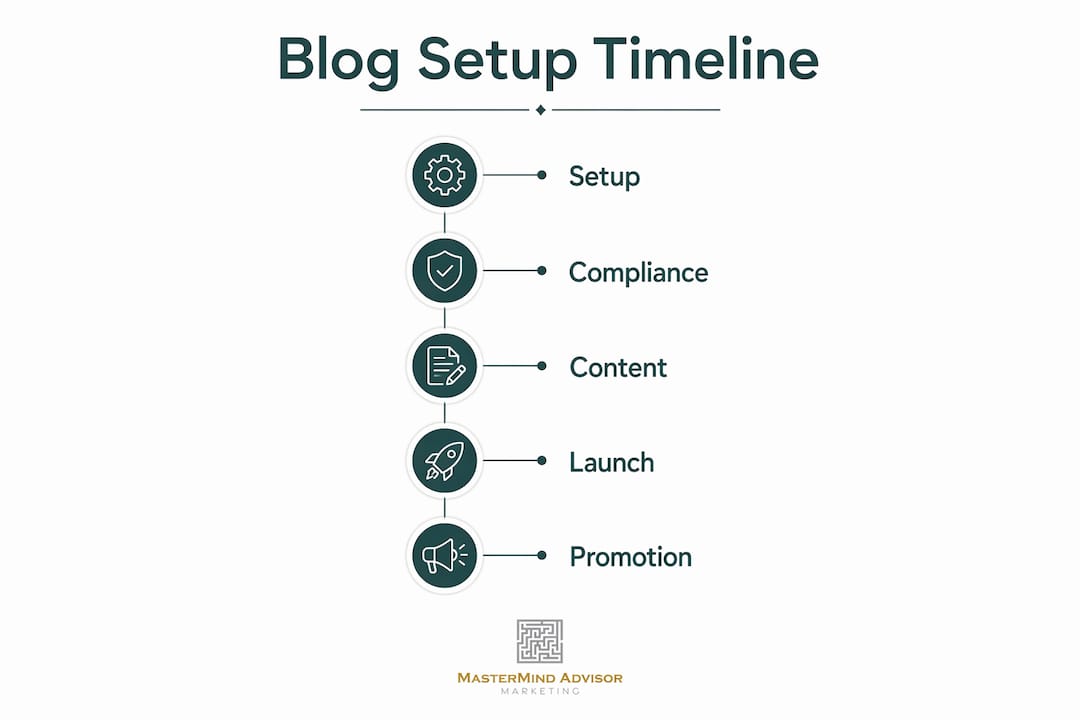
Budget ranges vary sharply by approach. DIY (hosting, plugins, your time) runs roughly $100–$300 per month in hard costs. A hybrid model, where you write and outsource design or SEO, typically runs $500–$1,500 per month. A full digital marketing strategy or turnkey vendor sits above that, but removes the time burden entirely.
How do you define your niche and build content pillars that attract qualified prospects?
A vague ICP produces vague traffic. Define yours by five dimensions: age range, life stage (accumulation vs. pre-retirement), investable assets, core financial concern, and preferred communication channel. A 52-year-old business owner with $800K in a SEP-IRA worried about succession and tax exposure is a far more useful ICP than "high-net-worth individuals." Use your niche selection framework to size the audience before committing.
Three pillar frameworks that consistently attract qualified financial planning prospects:
- Retirement planning: Social Security timing, RMD strategy, Roth conversion windows, Medicare cost planning
- Tax-aware accumulation: Tax-loss harvesting, backdoor Roth, HSA stacking, equity compensation planning
- Financial life transitions: Divorce financial planning, inheritance management, business sale proceeds, sudden wealth
For each pillar, map three layers: a broad ToFu keyword cluster (e.g., "when to take Social Security"), a MoFu comparison post (e.g., "Roth vs. traditional IRA at 55"), and a BoFu service page or case study. Every post you write should slot into one of these layers before you draft a single sentence. That discipline is what separates a financial literacy blog that compounds in value from a random collection of articles.
What content formats and CTAs actually convert at each funnel stage?
Format follows intent. At the top of the funnel, educational blog posts, short explainer videos, and downloadable guides do the work. Mid-funnel, calculators and webinars create stronger engagement and higher-quality leads than generic traffic spikes. At the bottom, case studies and direct consult invitations close the gap.
Stage-specific CTAs that work for financial advisors:
- ToFu: "Download our free Retirement Readiness Checklist" (newsletter or gated PDF)
- MoFu: "Join our live webinar: 5 Tax Moves Before Year-End" or "Try our Roth Conversion Calculator"
- BoFu: "Book a 20-minute discovery call" or "Request a complimentary financial plan review"
Every landing page behind a CTA needs four things: a clear outcome statement, compliant disclaimer language, qualifying fields (asset range, timeline, primary concern), and a CRM routing rule. The CTA placement and copy matter as much as the offer itself. A button that says "Get the Guide" outperforms "Submit" on nearly every test.
What does a compliant pre-publish checklist look like for advisor blogs?
Under the SEC Marketing Rule and FINRA Rule 2210, all blog content that solicits clients is advertising. Both RIA and broker-dealer advisors face pre-approval and recordkeeping requirements. In practice, both channels treat solicitation similarly: pre-approval and archiving are standard expectations regardless of registration type.
Pre-publish checklist:
- Disclosure language present and above the fold (educational intent, not personalized advice)
- No performance projections or guarantees
- Testimonials comply with SEC Rule 206(4)-1 conditions (disclosure, oversight, no misleading implication)
- Post archived with version history; SEC recordkeeping rules require a five-year retention period, with the first two years readily accessible
- Compliance principal sign-off documented before publication
Pro Tip: Build a pre-approved topic list with your compliance team quarterly. Advisors who share templates and prove low-risk content categories get faster approvals and publish more consistently.
Which tech tools do you actually need to run an advisor blog?
| Tool | Purpose | Best For |
|---|---|---|
| WordPress (self-hosted) | CMS, full control, plugin ecosystem | Advisors scaling content and SEO |
| Squarespace | Managed CMS, simpler setup | Solo advisors with limited tech support |
| HubSpot | CRM, landing pages, lead tracking | Advisors who want CRM and marketing in one |
| Mailchimp / ConvertKit | Email capture and nurture sequences | Any advisor building a list |
| Calendly + Zoom | Discovery call scheduling and webinars | BoFu conversion and MoFu webinars |
| Zapier | Automation between tools | Routing form fills to CRM without code |
Implementation checklist:
- Install SSL certificate and verify HTTPS on all pages
- Add a privacy policy and cookie consent banner (required for GA4 and lead capture)
- Set up secure form handling with field-level encryption where possible
- Connect GA4 for traffic tracking and CRM event tracking for lead attribution
- Configure Zapier to push form submissions from your CMS into HubSpot automatically
- Enable email archiving in your email platform for books-and-records compliance
How do you build an editorial calendar with a compliance review built in?
A 90-day cadence keeps the pipeline full without overwhelming a solo advisor. Batch topic selection monthly, draft weekly, and build a two-stage review: internal edit first, compliance review second. Never publish without a documented sign-off.
| Week | Task | Owner |
|---|---|---|
| Week 1 | Topic selection from pre-approved list | Advisor / editor |
| Week 2 | Draft + internal edit | Author |
| Week 3 | Compliance review + revisions | Compliance reviewer |
| Week 4 | Publish + promotion launch | Publisher |
Role definitions matter. The author drafts, the editor checks clarity and CTA placement, the compliance reviewer checks regulatory language, and the publisher schedules and archives. SLA: compliance review should return within five business days. Keep every version in a shared folder with timestamps. That audit trail satisfies the books-and-records archiving standard and makes future reviews faster.
Batch-produce content in blocks of four posts at a time. Write editorial briefs before drafting: ICP, pillar, funnel stage, target keyword, CTA, and required disclaimer. That brief becomes the compliance reviewer's checklist.
How do you promote posts and turn one article into multiple lead touchpoints?
One post, distributed well, generates more leads than five posts published and forgotten. The repurposing sequence:
- Publish the post with a ToFu or MoFu CTA
- Day +3: send a newsletter segment to your list with a teaser and link
- Day +7: post a LinkedIn article or short video snippet with a direct quote from the post
- Weeks 3–6: use the post as a webinar topic or include it in a nurture email sequence
Organic channels to prioritize: targeted SEO on long-tail keywords your ICP actually searches, a consistent email newsletter, and LinkedIn posts that demonstrate understanding of your prospect's specific problem before asking for contact. Paid promotion on high-intent search terms (e.g., "Roth conversion calculator for pre-retirees") accelerates results once organic content is indexed. For digital lead generation, the combination of SEO and email consistently outperforms paid-only approaches over a 12-month horizon.
When should you scale, A/B test, or bring in outside help?
Track five KPIs monthly: organic traffic by post, lead conversion rate by post, MQL-to-SQL conversion, cost per qualified lead, and estimated lifetime value of blog-acquired clients. When a post drives traffic but no leads, the CTA or landing page is the problem. When leads come in but don't convert to calls, the nurture sequence needs work.
A/B test ideas to run in months 4–9:
- CTA copy: "Download the Guide" vs. "Get the Checklist"
- Form length: three fields vs. six fields (shorter usually wins at ToFu)
- Lead magnet type: PDF guide vs. interactive calculator
- Webinar vs. calculator performance for MoFu conversion
The outsourcing trigger is straightforward: when your hourly value as an advisor exceeds what you spend per hour on content production, delegate content writing or technical setup. Keep strategy, ICP decisions, and compliance review in-house.
What templates can you use right now for posts and CTAs?
| Template | Structure | Key CTA |
|---|---|---|
| ToFu educational post | Problem → explanation → 3 takeaways → resource offer | "Download our free [topic] guide" |
| MoFu webinar landing page | Problem → solution preview → speaker bio → registration form | "Reserve your spot" |
| BoFu consult page | Client outcome → process → qualification fields → calendar embed | "Book your discovery call" |
Three-step email follow-up after lead capture:
- Day 0 (Welcome): Deliver the lead magnet, introduce yourself and your focus area, set expectations for future emails
- Day 4 (Value + qualify): Share a second resource, ask one qualifying question ("What's your biggest financial concern right now?")
- Day 10 (Invite): Offer a webinar or discovery call with a direct Calendly link
Compliant disclaimer for every CTA block: "This content is for educational purposes only and does not constitute personalized investment, tax, or legal advice. Please consult a qualified professional for guidance specific to your situation."
What results have advisors seen with a blog-led approach?
Advisors who commit to a consistent publishing cadence and a structured funnel report measurable shifts in lead quality within six months. The pattern is consistent: early posts build organic traffic, MoFu assets (calculators, webinars) convert that traffic into qualified leads, and CRM integration turns those leads into scheduled calls.
Key lessons from advisors who have run this playbook:
- What scaled: Evergreen posts on retirement and tax topics, webinar funnels, and automated email sequences
- What failed: Generic "financial tips" posts with no ICP focus and no CTA
- Practical adjustment: Advisors who added a qualifying question to their lead capture form reported a significant drop in unqualified leads within 60 days
How do you qualify and nurture leads after initial capture?
Capturing a lead is the start, not the finish. Segment new leads immediately by the qualifying fields on your form: asset range, timeline, and primary concern. Route high-fit leads (matching your ICP) to a priority nurture sequence; route lower-fit leads to a general educational drip.
Marketing automation steps that work for financial advisors: a five-email welcome sequence over 14 days, a monthly newsletter with one pillar topic per issue, and a behavioral trigger (e.g., clicking a calculator link) that moves a lead from general nurture to a BoFu sequence automatically via Zapier and HubSpot.
How does CRM integration connect your blog to your sales process?
HubSpot connects directly to WordPress and Squarespace via native integrations or Zapier. Every form submission should create a contact record, log the source post, and trigger a task for follow-up within 24 hours. Tag contacts by pillar interest and funnel stage so your outreach is specific, not generic.
Sales follow-up process: when a lead books a Calendly call, HubSpot should automatically send a pre-call questionnaire via email, log the meeting, and set a follow-up reminder for 48 hours post-call. That closed loop between blog, CRM, and calendar is what separates advisors who convert blog traffic into clients from those who just collect email addresses.
What security and privacy rules apply to lead data in financial services?
Financial services lead data carries higher risk than most industries. Use SSL on every page and form. Store lead data in a SOC 2-compliant platform (HubSpot qualifies). Never store sensitive financial data (account numbers, SSNs) in a marketing CRM. Your privacy policy must disclose what data you collect, how you use it, and how long you retain it.
For email capture, comply with CAN-SPAM at minimum: clear sender identification, physical address, and a one-click unsubscribe. If you serve clients in states with stricter privacy laws (California's CCPA, for example), add a "Do Not Sell My Data" option and a data deletion request process. Document your data handling procedures and review them annually.
How do you analyze competitor blogs to find content gaps?
Start with the advisors ranking for your target keywords in your geographic market or niche. Use a tool like Ahrefs or Semrush to identify which posts drive their traffic and which keywords they rank for that you do not. Look for three gap types: topics they cover shallowly (you can go deeper), topics they miss entirely (your ICP's specific concerns), and formats they skip (calculators, webinars, video).
Build a simple gap log: keyword, competitor ranking post, your planned angle, and target funnel stage. Prioritize gaps where search volume is moderate and the existing content is thin. A 2,000-word post with a calculator on a topic where competitors have only 500-word summaries will outrank and out-convert within months.
How do you make your financial blog accessible and inclusive?
Accessibility is both a legal consideration and a trust signal. Use heading hierarchy correctly (H1 → H2 → H3) so screen readers can navigate your posts. Add alt text to every image and chart. Ensure color contrast meets WCAG 2.1 AA standards, which matters especially for charts and infographics common in financial content.
Write at a reading level your ICP can follow without a finance degree. Plain language in financial content is not dumbing down; it is respecting your reader's time. Avoid jargon in ToFu posts; introduce technical terms with a brief definition at MoFu. Offer content in multiple formats (text, video, downloadable PDF) to serve different learning preferences and accessibility needs.
Key Takeaways
A financial advisor blog generates qualified leads when it combines a focused ICP, three mapped content pillars, stage-specific CTAs, and a documented compliance workflow from day one.
| Point | Details |
|---|---|
| Start with ICP and three pillars | Define your ideal client profile before writing a single post; map every post to a pillar and funnel stage. |
| Compliance is pre-publish, not post-publish | SEC Rule 206(4)-1 and FINRA Rule 2210 require pre-approval; archive all posts for a five-year retention period. |
| Stage-specific CTAs drive conversions | ToFu needs a guide or newsletter offer; MoFu needs a calculator or webinar; BoFu needs a direct discovery call invite. |
| CRM routing closes the loop | Connect your CMS form to HubSpot via Zapier so every lead is tagged, sequenced, and followed up within 24 hours. |
| Mastermindadvisormarketing as turnkey option | Advisors who prefer not to DIY can use Mastermindadvisormarketing's done-for-you system covering content, webinars, CRM, and automated follow-ups. |
Why your blog is your digital handshake, not a brochure
Most advisors treat their blog like a brochure: polished, generic, and written for no one in particular. That is the wrong frame entirely. A blog post that speaks directly to a 58-year-old business owner's anxiety about selling her company and managing the proceeds is not content marketing. It is a conversation she did not know she could have before she found you.
Content functions as a digital handshake. The advisors who get this right write posts that demonstrate they understand a prospect's specific problem before asking for any contact. The discovery call that follows is not a pitch; it is a continuation of a conversation the prospect already started in their head while reading your post.
The compliance piece slows people down, and I understand why. But advisors who build the pre-approval workflow upfront, with a quarterly pre-approved topic list and a documented sign-off trail, publish faster than those who treat compliance as an afterthought. The friction is front-loaded, not ongoing.
Blogging is not a short-term tactic. The advisors who win with content are the ones who treat it as a long-term relationship asset, not a lead-generation sprint. Publish consistently, map every post to your ICP, and let the funnel do its work over 12–18 months. The compounding effect on organic traffic and qualified leads is real, and it is durable in a way that paid ads are not.
Mastermindadvisormarketing: a done-for-you alternative for advisors who want results without the DIY
Building a compliant, lead-generating blog from scratch takes time most advisors do not have. Mastermindadvisormarketing is built specifically for independent financial advisors who want the results of a content-driven funnel without managing the moving parts themselves.
The system covers customized webinars, content marketing, a custom CRM, and automated email follow-ups, all designed around the specific needs of financial advisors. Before choosing any turnkey provider, ask four questions: Who owns your content and data? How is compliance review handled? What does the reporting cadence look like? And is pricing transparent with no hidden fees?
Mastermindadvisormarketing answers those questions directly. Advisors who have used the system report stronger lead quality and faster discovery-to-client conversion compared to managing content independently. To see how the system fits your practice, visit Mastermind Advisor and review the compliance and reporting workflows before committing.
This article is general information, not professional legal, compliance, or investment advice. Verify current SEC and FINRA requirements with a qualified compliance professional for your specific registration type and situation.
Authoritative references and regulatory resources
The sources below underpin the regulatory and tactical claims in this article. Bookmark them and surface them in your editorial workflow when drafting or reviewing posts.
- FINRA Social Media Rules and Guidance: the primary FINRA resource on communication rules, static vs. interactive content, and principal review requirements
- SEC Marketing Rule 206(4)-1 via LexFed: full regulatory text covering testimonials, performance claims, and advertisement definitions
- SEC Risk Alert: Investment Adviser Use of Social Media: recordkeeping expectations, five-year retention standard, and monitoring guidance
- FIG Marketing: Compliance Checklist for Financial Advisors: practical pre-publish checklist covering disclosures, testimonials, and archiving
- Kitces: Compliance Oversight for Financial Advisor Blogging: deep analysis of FINRA Rule 2210 vs. SEC Rule 206(4)-1 and how to build a workable compliance program
- Niara: Blog Posts That Generate Leads in Financial Services: funnel-stage content strategy, CTA frameworks, and disclaimer best practices
For templates, use the structures in this article's Templates section as your starting point. Archive every version of every post with a timestamp and the name of the compliance reviewer who approved it. That documentation is your first line of defense in any regulatory review.
Recommended
Originally published at source.