
Discover how financial advisors can automate lead capture effectively. Get faster responses, more qualified meetings, and a clear audit trail!
Automate Lead Capture for Advisors: The 2026 Playbook
The fastest compliant path to automated lead capture combines a clean CRM, AI-assisted inbound forms and chatbots, stage-triggered nurture sequences, and a supervisory review layer before anything sends. Firms that build in this order typically see faster response times, more qualified first meetings, and a defensible audit trail. Mastermind Advisor Marketing builds this exact stack for advisors who want it implemented, not just explained.
TL;DR:
- Clean and standardize your CRM data first, ensuring no duplicates or missing source tags, before automating lead capture processes.
- Utilize a simple, staged approach starting with a capture point, calendar booking, tagging in your CRM, and a basic automation trigger, then scale gradually.
- Focus on high-impact methods like webinars, live events, and referral automation for faster and higher-quality leads than traditional content marketing or paid directories.
- Maintain supervisory review for all AI-drafted messages, build a library of pre-approved templates, and test suppression lists monthly to ensure compliance and avoid mistakes.
- Prioritize building an accurate, clean data foundation and establishing supervisory review processes, as these are critical for successful automation outcomes.
Table of Contents
- How Do You Automate Lead Capture as a Financial Advisor?
- Which Lead Capture Methods Actually Work for Advisors?
- Building the Tech Stack: CRM, Middleware, and Tracking
- Keeping Automated Outreach Compliant and Supervised
- What Does a Realistic Rollout Timeline Look Like?
- How Do You Measure If the Automation Is Working?
- Real Results From Advisors Who Automated Lead Capture
- The Part Most Advisors Get Wrong About Automation
- Get a Turnkey System Built for This Exact Roadmap
- Sources
How Do You Automate Lead Capture as a Financial Advisor?
Before you touch a chatbot or write a single automation rule, run this readiness check. Skipping it is why most advisor automation projects stall after month two.
Start with your CRM. If you have duplicate contact records, missing source tags, or required fields that half your database never filled out, fix that first. Automation built on dirty data just sends the wrong message to the wrong person faster than a human ever could.
Next, match your traffic to your tactic. A chatbot or AI website agent only pays off once you have sufficient visitor volume. Below that threshold, a content-based capture form or a webinar funnel usually converts better and costs less to run.
Your minimum viable stack looks like this:
- A capture point (form, quiz, or chatbot) that pushes directly into your CRM
- A calendar tool that lets a prospect book a discovery call without a phone tag loop
- A CRM that tags source, stage, and consent status on every contact
- One automation trigger (usually "new lead created") that fires your first response
Pilot before you scale. Run one automation end to end with real leads for two to three weeks before adding a second channel. If it breaks, you want to know that with ten leads, not two hundred.
Pro Tip: *Before building anything, export 100 recent leads from your CRM and check for duplicate emails and blank source fields.
Which Lead Capture Methods Actually Work for Advisors?
Not every automated capture method performs the same way, and timelines vary more than most advisors expect.
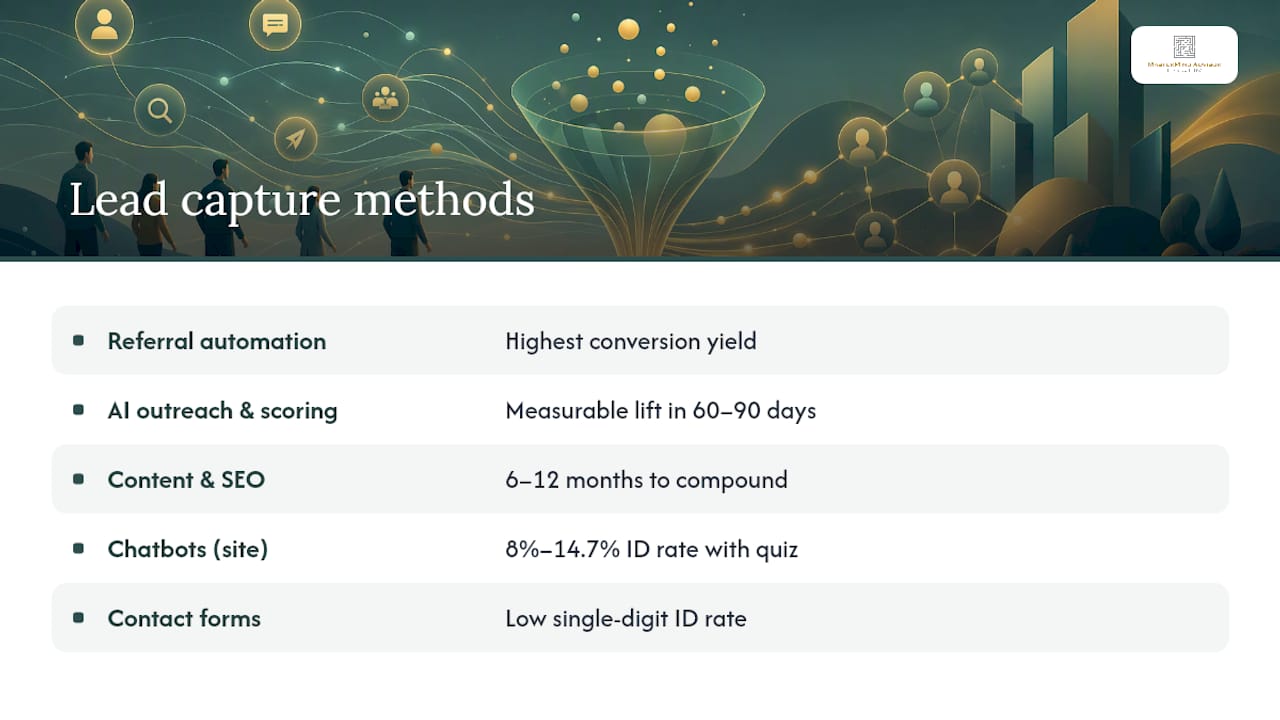
Landing pages and content marketing build inbound flow over months, not weeks. SEO-driven pages compound slowly. Structured AI-enabled outreach and scoring tend to produce measurable lift within 60 to 90 days, while content and SEO gains typically take 6 to 12 months to compound. Well-designed landing pages still matter. They're just a slower burn.
Webinars and live events convert faster because attendees self-select for high intent. A strong webinar registration funnel paired with automated reminder sequences routinely outperforms cold outreach on both speed and quality.
AI website agents and chatbots can turn 8% to 14.7% of anonymous visitors into identified prospects when paired with a structured quiz or assessment, compared to the low single digits a plain contact form typically pulls. That only holds once your site has enough traffic to feed the bot meaningful conversations.
Directories and paid lead providers fill the pipeline quickly but close at noticeably lower rates than warm referrals, and the leads often need heavier qualification before they're worth a scheduler's time.
Referral and reactivation automation consistently produces the highest conversion yield of any channel. A past client or a warm introduction already trusts you. Wiring referral requests and dormant-lead reactivation into your nurture system, rather than handling them manually, is one of the highest-leverage moves in this entire list. Generic B2B outreach tools often miss this because they're built for cold prospecting, not relationship intelligence and wealth-event monitoring that advisor-specific platforms are built around.
Building the Tech Stack: CRM, Middleware, and Tracking
Your CRM has to function as the single source of truth. Every other tool feeds it, and nothing overrides it. That means every contact record needs, at minimum: source, stage, consent status, and last-touch date populated consistently.
- Pick your integration pattern first. Native app integrations are the most stable but the least flexible. Webhooks give you the most control but require someone who can maintain them. Middleware like Zapier sits in between and is usually the right starting point for a solo advisor or small team.
- Wire in the essentials. That's a calendar tool, an email service provider, a compliance archiving system, and basic analytics. Skip any one of these and you lose either speed or your audit trail.
- Tag for scoring before you need it. Fields like household assets, life stage, and lead source should be captured at intake, not bolted on later once you decide to build a scoring model.
Integration tools like LeadsBridge show a consistent pattern in user reviews: teams that start with one or two simple connections have far fewer maintenance headaches than teams that try to wire many tools together initially.
Pro Tip: *One firm that started with a basic Zapier flow, moving new email leads into a spreadsheet and then into their CRM, saved several hours a week and cut data-entry errors once they layered in more automation gradually, according to a case documented by Kitces. Start simple. Complexity can be added gradually later

Keeping Automated Outreach Compliant and Supervised
Automation moves fast. Compliance review can't be the thing that slows it to a crawl, and it can't be skipped either.
Build a pre-approved template library first. Every automated email, text, and chatbot script should draw from templates that have already cleared supervisory review, rather than generating fresh language on the fly for every send.
Keep a human in the loop for anything AI drafts. The strongest advisor implementations use AI to draft outreach, route it through compliance for approval, and let the advisor add a short personal line before it goes out. That combination catches both regulatory issues and the generic tone that makes automated messages feel automated.
Suppression logic deserves more attention than it usually gets. Advisor-focused research points to suppression workflows as one of the most commonly neglected pieces of an automation build. A missed suppression rule means an active client receives a prospecting sequence meant for someone who's never heard of your firm. That's not just awkward. It's a real compliance exposure.
- Maintain a pre-approved template library with version control
- Route every AI-drafted message through supervisory review before it sends
- Test suppression lists monthly, not just at setup
- Archive every automated communication with timestamps for FINRA/SEC review
Test your suppression logic on the first of every month. It takes ten minutes and prevents the kind of mistake that's hard to walk back.
What Does a Realistic Rollout Timeline Look Like?
Automation projects fail most often because firms try to build everything simultaneously. A staged rollout avoids that.
- Weeks 1 to 4: CRM audit and cleanup. Deduplicate records, standardize source tags, and fill required fields. Nothing else should start until this is done.
- Weeks 2 to 4 (overlapping): Basic automation pilot. Wire up initial response emails and calendar scheduling for one lead source. Documenting the prospect journey first before building triggers cuts implementation time by roughly a third.
- Weeks 6 to 12: Add scoring and personalization. Layer in lead scoring, branch your nurture sequences by segment, and expand to a second or third channel.
Here's how the two most common paths compare on cost and effort:
| Approach | Setup cost | Ongoing cost | Who maintains it |
|---|---|---|---|
| DIY with Zapier + existing CRM | Low (mostly time) | Low monthly tool fees | You or an in-house team member |
| Managed turnkey system | Implementation fee upfront | Monthly retainer | External marketing partner |
DIY works if someone on your team has the time and the technical patience to troubleshoot broken integrations. A managed system trades that time cost for a predictable monthly fee and someone else owning the maintenance.
Success at each stage looks different: clean data and zero duplicate sends at Stage 1, a working response-to-booking flow at Stage 2, and a measurable lift in qualified meetings by Stage 3.
How Do You Measure If the Automation Is Working?
Three numbers matter more than the rest: response time to a new lead, conversion rate from lead to booked meeting, and cost per qualified appointment. Track them weekly, not quarterly. If your first automated response takes longer than five minutes, you're already losing prospects to whichever advisor replies first.
Run small tests instead of overhauling everything at once.
- A/B test your landing page headline against a version framed around a specific outcome rather than a service description
- Test send time for your first nurture email (morning versus evening)
- Test one qualifying question in your chatbot flow to see if it improves lead quality without tanking completion rates
Review your dashboard monthly at minimum, weekly if you're actively piloting something new. When a metric plateaus, adjust one lever at a time. Change your score threshold, shift your email timing, or add a qualification field. Changing three things simultaneously tells you nothing about what actually worked.
Real Results From Advisors Who Automated Lead Capture
Advisors working with a turnkey system see the pattern play out consistently: clean CRM data plus automated nurture plus a compliance layer produces steadier lead flow than any single tactic alone.
- Firms that moved from manual follow-up to automated first-response sequences report faster conversion from inquiry to booked meeting, according to practitioner reports
- Practices combining webinar funnels with automated nurture see stronger show-up rates than webinars run without a structured follow-up sequence
- Advisors who added pre-approved templates before automating reduced their compliance review time per campaign
Mastermind Advisor Marketing's system maps directly onto the architecture covered here: webinar strategy for high-intent capture, a digital lead growth plan for channel prioritization, and a custom CRM with automated follow-up built in from day one.
Pro Tip: Ask any marketing partner for a specific example of how they've handled suppression logic for an existing client base. If they can't answer clearly, that's a red flag worth taking seriously.
The Part Most Advisors Get Wrong About Automation
Most advisors treat automation as a technology purchase. It's not. It's a data discipline problem wearing a technology costume.
The conventional advice says "get a chatbot" or "start email automation." That advice skips the part that actually determines whether the project works: whether your CRM data is clean enough to automate against in the first place. I've seen the pattern often enough to call it a rule. Firms that automate on top of messy data get faster, more consistent mistakes. Firms that clean data first get faster, more consistent results. Same technology, opposite outcome.
The second thing conventional advice underweights is human-in-the-loop review. Full automation, with no advisor touch and no compliance gate, isn't actually faster once you count the cost of a bad send or a supervisory finding. The advisors getting real lift are the ones using AI to draft and score, while keeping a person in the approval chain.
If you take one thing from this, prioritize the unglamorous work: audit your CRM before you automate anything, and build your suppression logic before your first campaign goes out. Everything downstream depends on getting those two things right first.
— Josh
Get a Turnkey System Built for This Exact Roadmap
Building this stack yourself means becoming your own CRM administrator, compliance coordinator, and marketing technologist on top of running client meetings. Mastermind Advisor Marketing exists so you don't have to split your attention that way. The system comes with a custom CRM, automated email follow-up, pre-approved templates, and webinar funnels already built and wired together, not a list of tools you have to connect yourself.
A discovery call typically covers where your current lead flow is breaking down, whether your CRM needs cleanup before automation makes sense, and which capture method (webinar, landing page, or a combination) fits your practice's current traffic and referral base. For firms weighing a broader automation partner outside the advisor space, agency-side automation implementation offers a useful comparison point on process, though it's not built around advisor compliance needs the way this system is. Visit Mastermind Advisor to schedule a call and see whether a managed build fits where your practice is right now.
Sources
- Financial Advisor Lead Nurturing: Step-by-Step Automation Guide | US Tech Automations
- Streamlining lead management process with Zapier automation | Kitces
Recommended
Originally published at source.