
Build an advisor marketing budget using LTV:CAC math and 1–20% benchmarks. A practical worksheet and allocation rules for solo and small teams.
Advisor Marketing Budget: LTV:CAC Worksheet and 1–20% Benchmarks
Start by budgeting a few percent of revenue for most advisory firms, then check that number against your LTV:CAC ratio before you commit to it. The typical advisor spends an amount near industry averages, though solo practitioners often spend less and small teams tend to spend more. Whatever figure you land on, build compliance review and staff time into it from day one, not as an afterthought once invoices arrive.
TL;DR:
- Most advisory firms should allocate between 1% and 12% of revenue for marketing, depending on growth ambitions and firm size.
- A solo advisor with $400,000 annual revenue should budget between $20,000 and $48,000 annually for marketing under a growth-focused approach.
- Using the LTV:CAC ratio of at least 3:1 helps ensure marketing spending aligns with client value and keeps acquisition costs disciplined.
- A balanced channel mix prioritizes content and SEO for sustainable growth, while paid ads and events are more suitable for aggressive, rapid expansion.
- Regular quarterly review of CAC, LTV, and channel performance is critical to adjusting budget allocations effectively.
Table of Contents
- Advisor Marketing Budget Benchmarks: What Firms Actually Spend
- Choose a Budgeting Method That Fits Your Firm's Stage
- Allocating Your Budget Across Channels
- Building Your Annual Budget, Step by Step
- Measuring ROI: Metrics That Tell You What To Do Next
- Budgeting for Compliance Without Losing Speed
- What Changes When You Outsource the Whole System
- Marketing as Infrastructure, Not an Expense Line
- Ready to Hand Off the Budgeting Headache?
- Sources
Advisor Marketing Budget Benchmarks: What Firms Actually Spend
Most advisors have no formal number to anchor against, which is exactly the problem. Broadridge found that only 23% of financial advisors have a defined marketing strategy, meaning the majority are spending reactively, often triggered by a slow quarter rather than a plan. That gap between planned and ad-hoc spend is where a lot of wasted budget hides.
The dollar figures give you a starting point. SmartAsset's 2024 survey data shows the average advisor spent $15,908 on marketing, with team-based practices averaging around $23,200 and solo advisors spending just under $9,000. Those numbers matter less as absolutes and more as a sanity check: if you're spending $2,000 a year and expecting steady lead flow, the math simply doesn't support it.
Percent-of-revenue framing tends to be more useful because it scales with your firm. Select Advisors Institute lays out three bands that map cleanly to firm posture:
- Conservative/maintenance mode: 1%–3% of revenue, appropriate for firms with strong referral flow that just want to stay visible.
- Growth-focused: 5%–12% of revenue, the range where most independent advisors actively building a pipeline should sit.
- Aggressive/high-growth: 10%–20% of revenue, typically reserved for firms launching in a new market or racing to hit an acquisition-driven growth target.
Quick benchmark: a solo advisor billing $400,000 in annual revenue at the growth-focused rate would budget somewhere between $20,000 and $48,000 a year for marketing, before compliance and staff time.
Firm size changes the math beyond the percentage. A solo practitioner often pays retail rates for design, ad management, and compliance review because there's no internal capacity to absorb any of it. A mid-size RIA with five or more advisors can spread fixed costs like a website, CRM, and content calendar across a bigger revenue base, which usually pushes their effective per-client acquisition cost down even when their percent-of-revenue figure stays flat.

Choose a Budgeting Method That Fits Your Firm's Stage
Picking the right calculation method matters as much as picking the right number. XY Planning Network outlines three practical approaches that fit different stages of a firm's life.
- Time-cost method. New firms with little cash but plenty of hours should value their own time honestly, say $75 to $150 an hour depending on what you'd otherwise bill, then multiply by hours spent on content, networking, and outreach. This surfaces the real cost of "free" marketing, which is rarely actually free.
- Percent-of-revenue method. Pick a band from the benchmarks above based on your growth ambition, then apply it to trailing twelve-month revenue. This is the easiest method to explain to a partner or spouse and the one most established firms default to.
- Business-economics (LTV:CAC) method. Calculate your average client's lifetime value, set a target ratio (most advisory firms should aim for LTV:CAC of at least 3:1), then work backward to figure out what you can afford to spend acquiring each new client. This method forces discipline that percent-of-revenue alone doesn't.
A hybrid works well for firms transitioning out of startup mode: use percent-of-revenue to set the ceiling, then validate that ceiling against your LTV:CAC math before you sign any contracts. If the two numbers disagree by a wide margin, trust the LTV:CAC calculation. It's closer to the actual economics of your business.
Allocating Your Budget Across Channels
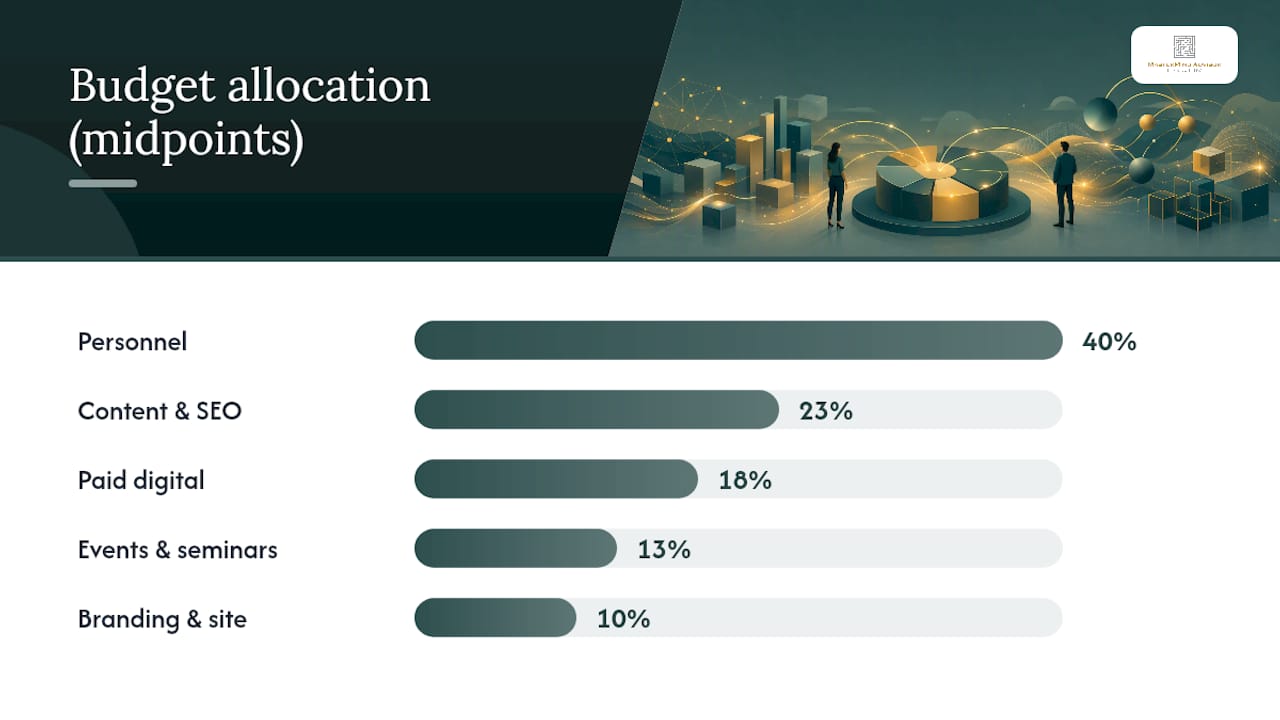
Once you know your total number, the allocation question is where most advisors get stuck. Select Advisors Institute's benchmarking data suggests these ranges as a starting framework:
- Personnel (internal staff or fractional CMO): 30%–50% of total budget
- Content and SEO: 15%–30%
- Paid digital advertising: 10%–25%
- Events and seminars: 5%–20%
- Branding and website: 5%–15%
- Marketing technology (CRM, automation): 5%–15%
- Compliance review: 3%–10%
How you weight those ranges depends on your priority. A firm chasing fast acquisition should push paid digital and events toward the top of their ranges, accepting a thinner content allocation for now. A firm building for sustainable, lower-cost growth over three to five years should invert that, favoring content and SEO since organic investment compounds and lowers CAC over time in a way paid spend simply doesn't. A firm focused on brand building in a competitive metro market should lean harder into branding and website spend, since differentiation is the whole point.
Paid channels carry a hard floor worth respecting, especially when managing costs in platforms like Google Ads Cost for Local Businesses: Budget Guide. Spreading $300 a month across Google Ads and Facebook rarely produces enough data to optimize anything, and in competitive advisory markets it often just disappears without a trace.
Pro Tip: Kitces' guidance on annual marketing strategy warns against underfunding individual channels to the point they never reach critical mass. Better to fully fund one or two channels than to spread thin dollars across five and starve all of them.
Building Your Annual Budget, Step by Step
Turn the frameworks above into an actual number with this sequence.
- Set your growth target. Decide how many net new clients you need this year, what average revenue per client looks like, and your timeline. If you want 15 new clients averaging $3,500 in annual revenue, that's $52,500 in new recurring revenue.
- Calculate lifetime value. Multiply average annual revenue per client by average client tenure in years. A client worth $3,500 a year who stays 12 years has an LTV of $42,000.
- Set your target LTV:CAC ratio. At a conservative 4:1 ratio, that $42,000 LTV supports a maximum CAC of roughly $10,500 per client.
- Derive total spend. If you need 15 clients and can spend up to $10,500 acquiring each, your ceiling is $157,500, though most firms should target well under the maximum ratio for a healthy margin cushion, not the absolute cap.
- Build in review gates. Set quarterly checkpoints to compare actual CAC against your target, and hold back 5%–10% of the total budget as a contingency line for the channel that outperforms mid-year.
The quarterly cadence matters more than the initial number. Budgets built once a year and never revisited tend to keep funding whatever channel felt right in January, regardless of what the data says by June.
Measuring ROI: Metrics That Tell You What To Do Next
Four numbers drive nearly every budget decision after the initial build: CAC (total marketing spend divided by new clients acquired), LTV (average annual revenue per client multiplied by average tenure), cost per lead, and ROMI, or return on marketing investment (revenue attributable to marketing divided by marketing spend).
Track these on a simple monthly dashboard rather than an annual spreadsheet reviewed once. Select Advisors Institute's own research notes that benchmark ranges vary widely by sample size, so use industry ranges as a direction, not gospel, and validate them against your own conversion data within two or three quarters.
- LTV:CAC below 3:1 signals you're overpaying to acquire clients relative to what they're worth.
- A repeatable channel with a rising conversion rate signals it's time to increase spend there specifically, not across the board.
- Margin capacity from strong revenue growth is the real permission slip to raise your overall percent-of-revenue target next year.
Budgeting for Compliance Without Losing Speed
Compliance review is not a rounding error. Skipping this step is how firms end up with a great campaign sitting in limbo for six weeks.
A few tactics reduce the friction without cutting corners:
- Build a pre-approved content library so recurring posts don't need fresh review each time.
- Use templated disclosures for common content types (webinars, email, social) rather than drafting language from scratch.
- Budget a modest retainer with compliance counsel rather than paying by the hour for every single piece.
- Set aside a small annual line for staff training and recordkeeping tools so review bottlenecks don't quietly grow each year.
Reference FINRA's compliance guidance when setting internal review standards, since your process should map to what regulators actually expect, not just what feels cautious.
What Changes When You Outsource the Whole System
A turnkey provider shifts your budget structure rather than just adding a line item. Mastermind Advisor Marketing runs customized webinars, produced seminars, compliance-ready content, and CRM-integrated email automation as one system, which typically means your personnel line shrinks while your agency-fee line grows. That trade often nets out favorably for solo and small-team advisors, since advisor-led marketing gets measurably harder to sustain as firms scale past a handful of advisors, and internal hours spent on campaigns are hours not spent with clients.
Marketing as Infrastructure, Not an Expense Line
Advisors who treat marketing as discretionary are the ones who cut it the moment a quarter gets tight, and that's exactly backward. Marketing is infrastructure. It should get funded like your CRM or your compliance software, on a schedule, whether or not last month felt slow.
Three signals tell you it's time to raise the number: your funnel produces leads repeatably rather than in bursts, your conversion rate holds steady month over month, and your margins have room to absorb a bigger spend without squeezing take-home pay. Document your assumptions when you set the budget, then revisit them every quarter. Firms that skip the review step usually keep funding whatever felt right in January.
— Josh
Ready to Hand Off the Budgeting Headache?
Building the calculations above by hand, then executing webinars, content, and follow-up sequences on top of your regular client load, is exactly why most advisors never get past the benchmark stage. Mastermind Advisor Marketing replaces that internal time cost with a turnkey system built specifically for how advisors sell: compliance-ready content, automated email follow-ups, custom CRM integration, and full-scale webinars and seminars, all mapped to the allocation ranges covered above.

This fits best for solo and small-team advisors who've validated their LTV:CAC math and are ready to convert internal hours into agency-managed output, rather than firms still testing whether marketing works for them at all. If you want to see how the system performs for advisors with a similar client base to yours, review real advisor results and client testimonials and get a sense of what a properly funded, fully executed marketing budget actually delivers.
Sources
For ongoing benchmarking, keep SmartAsset's advisor marketing spend data, Select Advisors Institute's cost guide, and Kitces' annual strategy framework on hand when you revisit your numbers each quarter.
This article is general information, not a substitute for advice from a qualified financial advisor. Consult a qualified financial professional about your own circumstances before acting on anything here.
- How Much Financial Advisors Should Spend on Marketing
- Broadridge press release: 23 percent of financial advisors have a defined marketing strategy
Recommended
Originally published at source.