
Compliance first local SEO for advisors: set GBP as an SAB, build one city page, and run compliant review requests to see Map Pack movement in 6–10 weeks.
Win Your City Without Risk: Compliance First Local SEO for Advisors

Advisor local SEO comes down to three moves, done in order: a fully built Google Business Profile, one real city page, and a compliant review request system running in the background. Advisors who execute all three correctly typically see Map Pack movement in 6 to 10 weeks, with organic city-keyword rankings following several months later. Every step involving client reviews or testimonials needs a pass through compliance first, since the SEC's marketing rule governs how advisors can solicit and display them.
TL;DR:
- Properly optimizing Google Business Profile, creating a detailed city page, and establishing a compliant review system can produce Map Pack improvements within 6 to 10 weeks.
- Building locally specific city pages with real content and references to neighborhoods significantly outperforms thin or templated pages in search rankings.
- Citation cleanup by ensuring consistent business information across key directories is essential for building trust and boosting local rankings.
- Gathering reviews requires compliance approval, timing requests after client milestones, and responding promptly to reinforce local reputation signals.
- Investing $1,500 to $3,000 monthly in local SEO typically leads to measurable progress in rankings and lead volume within three to six months.
Table of Contents
- Quick Wins Checklist: What To Do In Weeks 1 Through 10
- How Do You Set Up Google Business Profile As A Service-Area Business?
- What Makes A City Page Actually Rank?
- Why Citation Cleanup Matters More Than Advisors Think
- How Do You Get Reviews Without Breaking Compliance Rules?
- Which Technical Fixes Actually Affect Local Rankings?
- What Keywords Should A Local Advisor Target?
- How Long Does It Take For Local SEO To Work?
- Common Setup Mistakes That Quietly Kill Rankings
- How Mastermind Advisor Marketing Maps To These Tasks
- What One Habit Separates Advisors Who Win Locally
- Primary Sources And Tools To Implement This
- Sources
- FAQ
Quick Wins Checklist: What To Do In Weeks 1 Through 10
Most advisors waste their first month on the wrong tasks. Here's the actual order that moves the needle fastest:
- Claim and verify your Google Business Profile. Choose the most specific primary category available (not "Financial Consultant" if "Financial Planner" fits better), and set up your service areas correctly from day one.
- Publish one fully built city page. Not a template with the city name swapped in. Real content, real proof, local references.
- Audit your top ten citations and fix your NAP. Business name, address, and phone number need to match everywhere, starting with the directories that carry the most weight.
- Turn on a compliant review request workflow. Trigger it after a specific onboarding milestone, not randomly.
- Run a mobile speed check and fix the worst offender. Usually it's an oversized image or a font file blocking render.
Pro Tip: Do the GBP setup and the city page in the same week. Google tends to reward profiles that show coordinated signals early, and waiting three weeks between the two makes it look like an abandoned project that got picked back up.
How Do You Set Up Google Business Profile As A Service-Area Business?
Financial advisors almost always operate as service-area businesses rather than storefronts, which changes how the whole profile gets configured. Get this piece wrong and everything downstream suffers.
Start with category selection. "Financial Planner," "Investment Service," or "Financial Consultant" all exist as distinct GBP categories, and picking the wrong one can bury you in irrelevant search results. Pick the one that matches your actual practice, not the one with the most search volume.
For service areas, BrightLocal's guidance is blunt: list specific cities or zip codes, never a radius. A 25-mile radius from your office tells Google nothing about which neighborhoods you actually want to rank in. Naming Denver, Aurora, and Lakewood by name does.
Fill out every field GBP offers:
- Services menu with each offering listed separately (retirement planning, tax strategy, estate planning)
- A full 750-character business description that names your niche and credentials
- Real photos of your office, team, and any in-person events
- Regular Posts, updated at least monthly
- A monitored Q&A section, since abandoned questions look worse than none at all
If you're an SAB, hide your street address in the profile settings. Showing it when you don't serve walk-in clients confuses Google's algorithm about your business model and can trigger a suspension review. One BrightLocal-cited pattern worth knowing: profiles using virtual office addresses get flagged and suspended at a noticeably higher rate than those using a real operating address with the visibility toggled off.
What Makes A City Page Actually Rank?
A city page that exists just to hold a city's name in the URL will not rank, and Google has gotten good at spotting the pattern. Practitioner data on service-area business pages shows pages built with 800 or more words of genuinely local content consistently outperform thin templated ones.
Build one real page per market you serve, and make each one distinct:
- Name the specific services you offer in that city and why local clients need them (state tax quirks, local retirement plans, regional cost-of-living factors)
- Reference actual neighborhoods, not just the city name, since "serving clients in Cherry Creek and Highlands Ranch" reads as local in a way "serving Denver" doesn't
- Include a client story or case reference tied to that market, where compliance allows
- State response times and how meetings work (in-person, virtual, or both)
Use a clean URL structure like /financial-advisor-denver-co rather than a generic /locations/1234. In your title tag and H1, pair the city with your specialty rather than a generic phrase, since "Retirement Planning Advisor in Denver" beats "Denver Financial Services" for both relevance and click-through.
Link every city page to your core service pages and to one or two blog posts that reinforce local expertise. Then mark up each page with LocalBusiness and Service schema, listing every city you serve under areaServed. That structured data tells search engines directly which markets each page targets, instead of making them guess from the text.
Why Citation Cleanup Matters More Than Advisors Think
Inconsistent business listings are one of the quietest ways advisors sabotage their own rankings. Google cross-references your name, address, and phone number across the web, and mismatches erode trust in your profile even when your GBP itself looks perfect.
Start the audit where it matters most:
- Google Business Profile first, since it's the anchor record everything else gets compared against
- Chamber of commerce listings and CFP Board or industry-specific directories next
- Major data aggregators (the sites that feed hundreds of smaller directories) after that
When you fix a listing, use your exact legal business name, your real direct phone number (never a call-tracking number that changes), and consistent formatting down to abbreviations like "St." versus "Street."
If a directory forces you to enter a street address and you operate as an SAB, list your primary office city with a "by appointment only" notation rather than leaving it blank or faking an address. A citation tracker (Moz Local and Yext are common choices) makes ongoing monitoring far less painful than manually rechecking dozens of listings every quarter.
How Do You Get Reviews Without Breaking Compliance Rules?
Reviews are the single fastest-moving local ranking signal advisors have. They're also the one with the most regulatory risk attached, so nothing here should ship without a compliance sign-off first.
- Draft your request template and route it through compliance before it ever reaches a client. The SEC's marketing rule guidance covers testimonials and third-party reviews directly, and what's acceptable varies by firm structure and state.
- Automate the trigger, not the wording. Send the request after a defined milestone, like a completed onboarding call or first-year review, rather than at random.
- Pick a channel your clients actually use. Email works for most advisory clients; SMS often gets a faster response but needs its own compliance review for consent language.
- Encourage specificity without scripting it. A review mentioning your city and the specific service tends to carry more local weight than a generic five-star rating with no detail, according to service-area business SEO analysis. Never write or suggest exact phrasing for a client to post.
- Respond to every review within a few days, and use the response to reinforce your service area and specialty without disclosing account details.
Pro Tip: When a satisfied client mentions they're happy on a call, ask right then if they'd be willing to leave a quick note about their experience. Reviews requested in the moment convert at a far higher rate than a cold email sent two weeks later.
Which Technical Fixes Actually Affect Local Rankings?
A slow site undermines every other effort on this list, because Google factors page experience into ranking and prospects abandon a laggy mobile page before they ever see your credentials.
Run your site through PageSpeed Insights or Lighthouse and triage in this order:
- Oversized images first, since they're usually the single biggest Largest Contentful Paint (LCP) offender
- Server response time (TTFB) next, particularly if you're on shared hosting
- Render-blocking JavaScript and CSS after that
- Click-to-call buttons on every contact point, checked specifically on a phone, not just a desktop browser
Make sure every city and service page is included in your XML sitemap and carries Service schema, not just your homepage. Check Core Web Vitals in Search Console monthly, and if a fix requires touching the site's codebase rather than a plugin setting, that's the point to bring in a developer rather than trying to patch it yourself.
What Keywords Should A Local Advisor Target?
The winning formula combines three elements: city, service, and niche or credential. "Fee-only retirement planner in Boulder" will convert better than "financial advisor" ever will, because it filters for exactly the client you want before they even click.
Build your content around a few core templates:
- A dedicated city landing page for each market, built to the standard covered above
- A "how to choose a financial advisor in [city]" guide that answers real buyer questions and naturally earns links from local publications
- Specialty landing pages for each niche you serve (divorce planning, small business owners, pre-retirees) paired with your top one or two markets
Publish consistently rather than in bursts. A long-tail keyword strategy built around specific client situations, rather than broad terms like "wealth management," tends to attract prospects who are further along in their decision and easier to convert on a first call.
How Long Does It Take For Local SEO To Work?
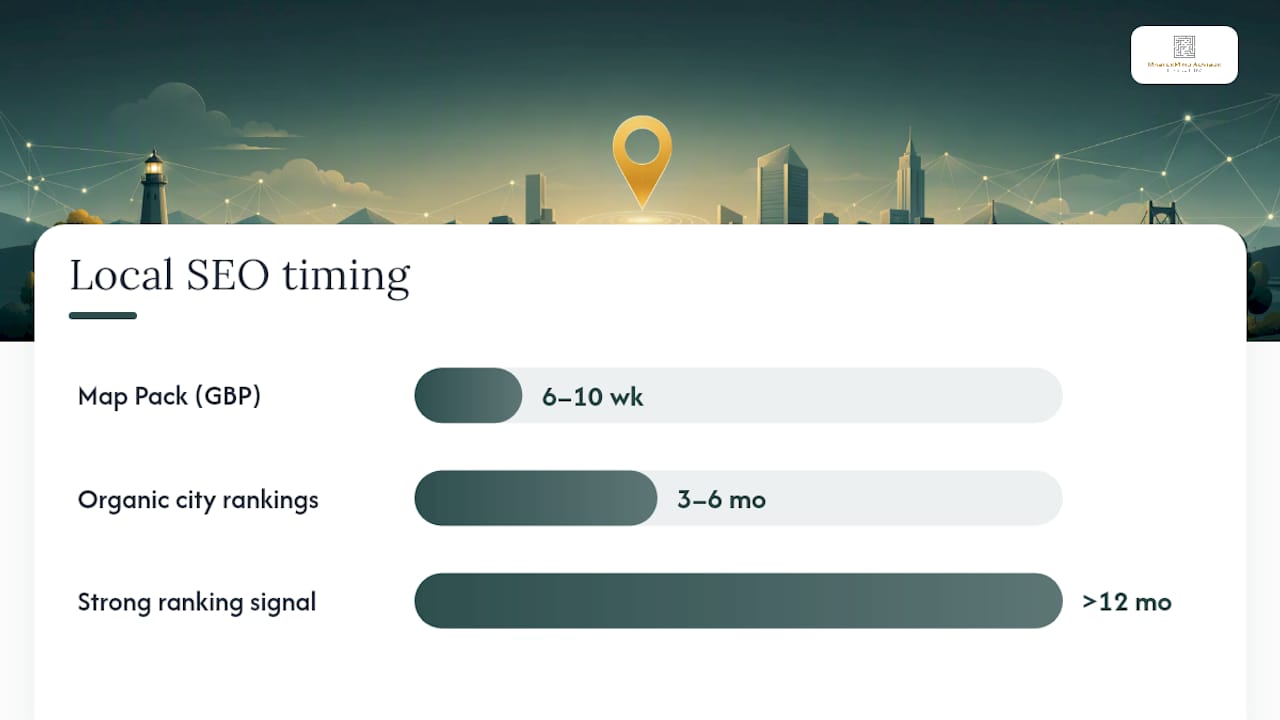
Map Pack visibility and organic rankings move on different clocks, and advisors who don't know that get discouraged too early. GBP optimization paired with early reviews often produces visible Map Pack gains within 6 to 10 weeks. Organic rankings for city keywords take longer, typically 3 to 6 months, and firms investing $1,500 to $3,000 a month in local SEO tend to see measurable progress within that window.
Track these numbers monthly:
- GBP calls, direction requests, and website clicks from the Insights panel
- Impressions and search queries triggering your profile
- Organic position for your top 5 to 10 city keywords
- Review growth rate (new reviews per month, not just total count)
- Lead-to-appointment conversion rate from local traffic specifically
Google Search Console, GBP Insights, a rank tracker, and a citation monitoring tool cover the basics. Tracking the right performance metrics consistently, rather than checking rankings sporadically, is what actually lets you tell whether a slow month is normal variance or a real problem. If you've maintained strong rankings in your core city for over a year and lead flow has plateaued, that's the signal to consider a satellite location rather than pushing harder on the same market.
Common Setup Mistakes That Quietly Kill Rankings
Most advisor GBP problems trace back to one of a handful of repeat offenders.
- Using a virtual office or a coworking address to appear more established. Google flags these patterns, and suspension can wipe out months of accumulated review and post history overnight.
- Letting NAP details drift out of sync across directories after an office move or phone number change, which quietly erodes the trust signals tying your listings together.
- Publishing near-identical city pages with the city name swapped and nothing else changed, which risks keyword cannibalization between your own pages instead of ranking either one well.
- Leaving GBP features dormant. Posts, Q&A, and the services menu all send freshness signals, and a profile that hasn't posted anything in six months looks abandoned to both Google and prospects.
How Mastermind Advisor Marketing Maps To These Tasks
Every task above, from GBP optimization to city page builds to compliant review workflows, is exactly what Mastermindadvisormarketing handles as part of its turnkey system for independent advisors. Custom CRM and automated email follow-ups can tie directly into review request and lead nurturing steps, with content libraries often built to consider compliance from the start. Advisor SEO strategists have written detailed breakdowns on GBP setup for advisors and the broader role SEO plays in advisory firm growth.
What One Habit Separates Advisors Who Win Locally
The advisors who pull ahead locally aren't the ones with the biggest budgets. They're the ones who pair city-specific proof with a follow-up system that actually runs on autopilot. A generic testimonial page does far less work than three reviews mentioning your city by name, refreshed monthly, backed by GBP Posts on a real cadence and review requests sent the week after onboarding, not the month after. Small teams that build this rhythm outperform firms three times their size that treat local SEO as a one-time setup task. For a deeper walk-through of the compliance-first approach, see the Map Pack playbook.
— Josh
Primary Sources And Tools To Implement This
- Google's own guidance for service-area businesses covers the exact fields and settings referenced throughout this piece.
- SEC marketing compliance FAQs should be your first stop before any review request goes live.
- BrightLocal's SAB guide and the 2026 advisor SEO benchmark report offer the timeline and configuration data cited above.
- Moz Local, Yext, and Google Search Console cover citation monitoring and rank tracking for most independent practices.
This article is general information, not a substitute for advice from a qualified financial advisor. Consult a qualified financial professional about your own circumstances before acting on anything here.
Sources
- Google Business Profile help — service businesses
- GBP for service area businesses – BrightLocal
- SEC marketing compliance FAQs
- Financial Advisor SEO: 2026 Benchmarks from 41 Advisory Firms
FAQ
How Much Should I Pay For Local SEO?
Advisory firms typically see measurable progress investing $1,500 to $3,000 per month, though a solo advisor doing GBP and citation cleanup manually can start for the cost of time alone.
What Is The 80/20 Rule In Local SEO?
For advisors, most ranking gains come from a fully optimized Google Business Profile and a handful of strong city pages, not from dozens of scattered tactics.
Is Local SEO Still Relevant For Financial Advisors?
Yes. Service-area business features on Google Business Profile, combined with city-specific content, remain one of the most reliable ways advisors get found by prospects searching in their exact market.
What Will Local SEO Look Like For Advisors In 2026?
Expect more weight on structured data, city-specific review content, and authored content tied to named, credentialed advisors, since trust-focused signals already correlate with stronger performance in trust-sensitive searches like advisor selection.
How Long Until I See Results From Advisor Local SEO?
Map Pack visibility often moves within 6 to 10 weeks of a proper GBP setup, while organic rankings for city keywords typically take 3 to 6 months to show meaningful movement.
Recommended
Originally published at source.